
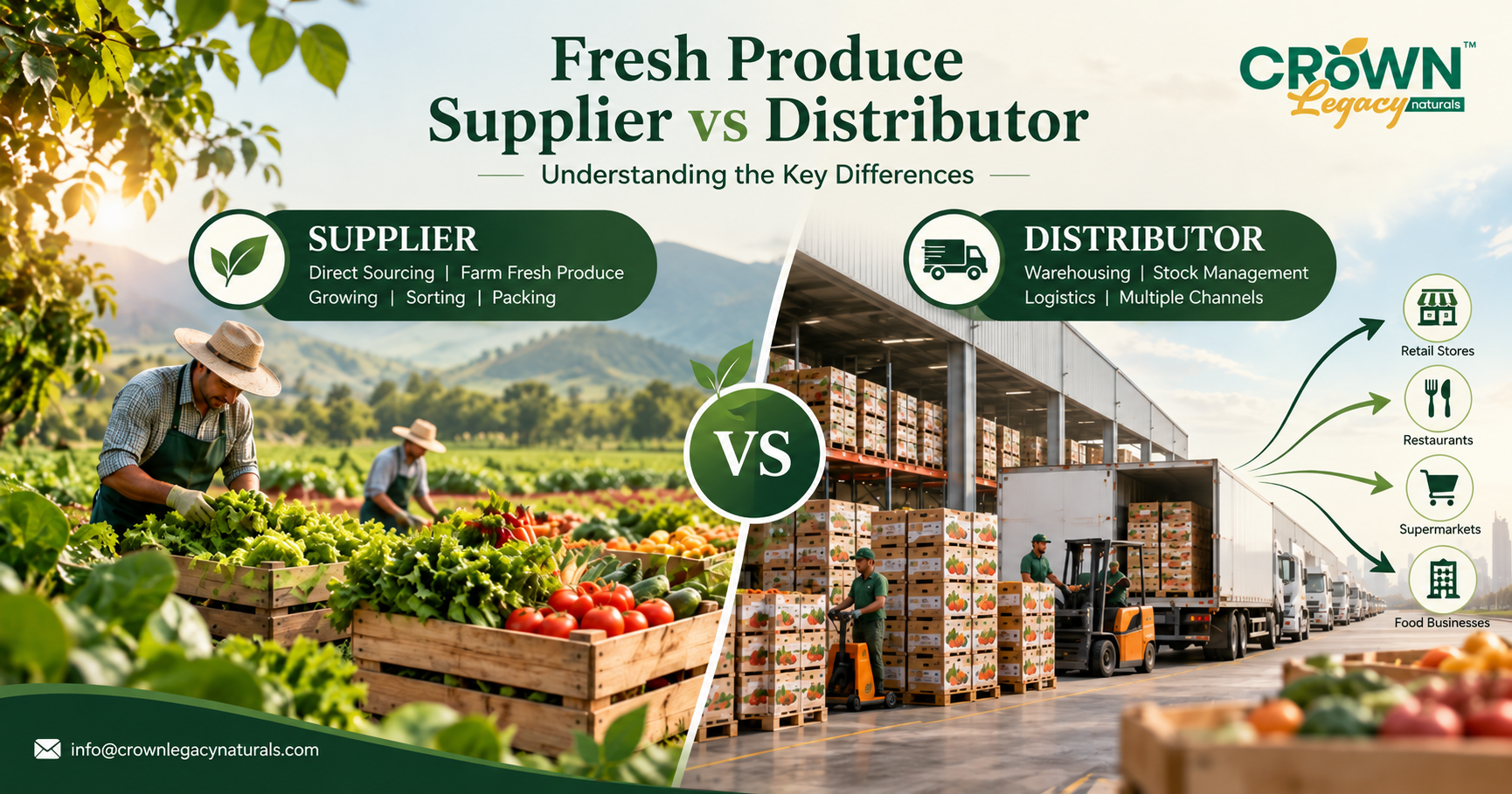
A fresh produce supplier vs distributor comparison comes down to their role in the supply chain. A supplier primarily provides or sources fresh produce for buyers, while a distributor typically manages the movement of produce from producers or suppliers to retailers, wholesalers, foodservice businesses, or other buyers. The right option depends on your sourcing needs, order volume, market, and supply requirements.
What Is the Difference Between a Fresh Produce Supplier and Distributor?
The main difference between a fresh produce supplier vs distributor is where each business fits within the produce supply chain.
A fresh produce supplier provides fruits and vegetables to buyers and may source directly from farms, growers, agricultural networks, or other supply partners.
A fresh produce distributor generally focuses on moving and supplying produce across a market or region. Distributors may purchase products from growers or suppliers and then sell them to supermarkets, retailers, restaurants, foodservice businesses, wholesalers, and other commercial buyers.
The distinction can vary between businesses because some companies perform both sourcing and distribution functions.
Factor | Fresh Produce Supplier | Fresh Produce Distributor |
Primary role | Sources or supplies produce | Distributes produce to downstream buyers |
Sourcing | May work directly with growers | May source from growers or suppliers |
Typical buyers | Importers, wholesalers, retailers, distributors | Retailers, restaurants, wholesalers, foodservice |
Supply model | Direct or specialized supply | Distribution across markets or regions |
Product range | May specialize in selected produce | May carry broader market inventory |
Geographic reach | Can support domestic or international buyers | Often focused on specific distribution markets |
Order model | Can support customized sourcing | Often works with established distribution channels |
Understanding these differences helps buyers determine which type of business fits their procurement model.
What Does a Fresh Produce Supplier Do?
A fresh produce supplier primarily focuses on making fresh fruits and vegetables available to commercial buyers according to their product and quantity requirements.
Depending on the company, a supplier may work directly with growers or use established agricultural sourcing networks.
Its responsibilities may include:
- Sourcing fruits and vegetables
- Selecting suitable varieties
- Managing product specifications
- Coordinating grading and quality checks
- Arranging suitable packaging
- Managing seasonal supply
- Supplying agreed quantities
- Coordinating orders with buyers
For international buyers, the supplier may also coordinate the requirements associated with preparing fresh produce for export.
The exact role depends on the company’s business model. Some suppliers operate close to the production side of the supply chain, while others work with multiple growers and sourcing partners.
What Does a Fresh Produce Distributor Do?
A fresh produce distributor generally operates closer to the market and focuses on moving produce from suppliers or producers to commercial customers.
Distributors can purchase or receive produce from multiple sources and make it available to buyers through established distribution channels.
Their activities may include:
- Purchasing fresh produce
- Managing inventory
- Warehousing
- Coordinating transportation
- Supplying retailers
- Supplying restaurants and foodservice businesses
- Serving wholesale customers
- Managing regional distribution
For example, a supermarket chain may purchase vegetables from a distributor that consolidates products from multiple suppliers and delivers them to several locations.
This makes distribution particularly relevant when a buyer needs regular access to multiple products within a specific geographic market.
How Does a Fresh Produce Supplier vs Distributor Model Work?
The fresh produce supplier vs distributor difference becomes clearer when looking at how produce moves through the supply chain. Buyers should consider the Indian Fruit & Vegetable Import Calendar before closing the deal.
A simplified supply chain may look like:
Farmer/Grower → Supplier → Distributor → Retailer/Foodservice → Consumer
However, not every supply chain follows this exact structure.
Another model may be:
Farmer/Grower → Supplier → Importer/Wholesaler → Retailer
Or:
Farmer/Grower → Distributor → Restaurant/Foodservice Business
Some businesses combine multiple roles, meaning a company can source produce directly from growers while also distributing it to commercial customers.
Therefore, buyers should understand the actual role a company performs rather than relying only on the label “supplier” or “distributor.”
When Should You Choose a Fresh Produce Supplier?
A supplier can be appropriate when your priority is sourcing specific fruits or vegetables according to defined requirements.
You may consider working with a fresh produce supplier when you need:
- Specific fruit or vegetable varieties
- Direct or structured sourcing
- Customized product specifications
- Recurring supply
- Larger commercial quantities
- Seasonal produce
- Export-oriented sourcing
- Specific grades or sizes
For example, an importer looking for Indian mangoes, pomegranates, grapes, okra, green chillies, or other produce may work directly with a supplier that has established sourcing relationships in the relevant production regions.
The important consideration is whether the supplier can consistently meet your product, quantity, quality, and delivery requirements.
When Should You Choose a Fresh Produce Distributor?
A distributor may be suitable when you need regular access to multiple products through an established distribution network.
A fresh produce distributor can be particularly relevant when you:
- Operate retail stores
- Run restaurants or foodservice operations
- Need frequent local deliveries
- Require multiple produce categories
- Need regional distribution
- Prefer purchasing from one consolidated source
For example, a restaurant group may prefer a distributor that can provide multiple vegetables and fruits through regular deliveries rather than managing relationships with several individual suppliers.
The appropriate model depends on the buyer’s location, purchasing volume, product requirements, and supply-chain structure.
How Does a Fresh Produce Supplier India Compare With a Fresh Produce Distributor India?
When comparing a fresh produce supplier India with a fresh produce distributor India, the key consideration is the buyer’s position in the supply chain.
An importer may prefer a supplier with strong sourcing capabilities if the goal is to purchase produce directly from the source market.
A retailer or restaurant operating within a local market may instead prefer a distributor that already maintains regional inventory and delivery networks.
Fresh Produce Supplier India
A supplier may offer:
- Source-market access
- Farm or grower relationships
- Product-specific sourcing
- Export supply
- Seasonal sourcing
- Customized specifications
Fresh Produce Distributor India
A distributor may offer:
- Market-level distribution
- Multiple product categories
- Regional supply
- Inventory management
- Frequent deliveries
- Consolidated purchasing
However, these characteristics are not universal. Some Indian businesses combine both models and can source directly while distributing products to different types of buyers.
What Is the Difference Between a Fruit Supplier vs Distributor?
The fruit supplier vs distributor distinction follows the same basic supply-chain principle.
A fruit supplier primarily focuses on sourcing and supplying fruit to buyers. A distributor generally focuses on moving fruit from suppliers or producers into established commercial markets.
For example:
Grower → Fruit Supplier → Importer
is different from:
Grower/Supplier → Fruit Distributor → Retailer
A buyer seeking specific fruit varieties, grades, or export quantities may prefer to work with a supplier that specializes in sourcing.
A retailer requiring frequent deliveries of multiple fruit varieties may find a distributor more suitable.
The right model depends on the buyer’s requirements rather than the terminology used by the company.
What Is the Difference Between a Vegetable Supplier vs Distributor?
The vegetable supplier vs distributor comparison is similar to the fruit supply chain.
A vegetable supplier may focus on sourcing particular vegetables, varieties, grades, and quantities from growers or agricultural markets.
A distributor may consolidate vegetables from different suppliers and distribute them to commercial buyers across a particular market.
For example:
Farmer → Vegetable Supplier → International Buyer
may be appropriate for an importer looking for specific Indian vegetables.
In contrast:
Multiple Suppliers → Distributor → Restaurants/Retailers
may work better for a buyer that requires multiple products delivered regularly within a local or regional market.
How Does a Wholesale Fresh Produce Supplier Differ From a Distributor?
A wholesale fresh produce supplier typically provides fresh produce in commercial quantities, often to importers, wholesalers, retailers, foodservice businesses, or other commercial buyers.
The word “wholesale” describes the purchasing model or volume rather than necessarily defining the company’s role in the supply chain.
A wholesale supplier may:
- Source directly from growers
- Consolidate products
- Supply large quantities
- Handle specific produce categories
- Work with domestic or international buyers
A distributor may also sell wholesale quantities, but its primary function may include inventory management, warehousing, transportation, and distribution to multiple downstream customers.
Therefore, wholesale supply and distribution can overlap.
Which Is Better: A Fresh Produce Supplier or Distributor?
There is no single model that fits every buyer. The appropriate choice depends on what you need from the supply chain.
Consider a fresh produce supplier when your priority is:
- Specific produce sourcing
- Direct source-market access
- Customized specifications
- Larger or recurring quantities
- International sourcing
- Seasonal products
Consider a fresh produce distributor when your priority is:
- Local or regional availability
- Frequent deliveries
- Multiple product categories
- Established distribution networks
- Inventory access
- Consolidated purchasing
Instead of asking which model is generally better, buyers should identify which model fits their procurement requirements.
What Should Buyers Check Before Choosing a Supplier or Distributor?
Before entering a commercial relationship, buyers should evaluate the company’s actual capabilities rather than relying only on its business description.
Check:
- Product range
- Product quality
- Sourcing network
- Supply capacity
- Geographic coverage
- Seasonal availability
- Packaging options
- Storage capabilities where relevant
- Pricing
- Minimum order quantity
- Delivery arrangements
- Export experience where applicable
- Certifications
- Communication and buyer support
For international buyers, it is also important to establish whether the company is actually responsible for exporting the products or whether another party handles the export process.
How Can Buyers Decide Between a Supplier and Distributor?
The simplest way to make the decision is to start with your own purchasing requirements.
Ask:
- Do I need products directly sourced from a particular country or region?
- Do I need specific fruit or vegetable varieties?
- What quantity do I purchase?
- Do I need recurring supply?
- Do I need local delivery?
- Do I need multiple produce categories?
- Am I importing directly?
- Do I need customized specifications?
- Do I need a single company to consolidate multiple products?
- Which part of the supply chain do I want the supplier to manage?
Your answers will help determine whether a supplier, distributor, or company performing both functions is the more relevant business model for your requirements.
How Does the Supplier vs Distributor Difference Affect International Produce Sourcing?
For international buyers, understanding the fresh produce supplier vs distributor distinction can make sourcing decisions more structured.
A buyer importing produce from India may want to work with a company that has direct access to Indian growers and sourcing regions.
Another buyer may already have an importer or distributor and simply need a reliable source of particular products.
The important point is to identify where the company sits in the supply chain and what responsibilities it actually handles.
This helps avoid confusion about pricing, product availability, sourcing, delivery, and the number of intermediaries involved in the transaction.
How Can Crown Legacy Naturals Support Fresh Produce Sourcing?
For buyers looking to source fresh fruits and vegetables from India, Crown Legacy Naturals operates around the sourcing and export side of the fresh-produce supply chain.
The company connects international buyers with fresh produce sourced from India, covering product categories such as fruits and vegetables for overseas markets.
For buyers, the important consideration is whether the available produce, specifications, quantities, and sourcing capabilities align with their requirements.
Understanding the difference between a supplier and distributor can help buyers ask the right questions and select the supply-chain partner that fits their procurement model.
Conclusion
The key difference between a fresh produce supplier vs distributor is their role in the supply chain. A supplier generally focuses on sourcing and supplying produce, while a distributor typically focuses on moving produce through established markets and distribution channels. However, some businesses perform both functions.
For importers and commercial buyers, the right choice depends on sourcing requirements, product specifications, order volumes, destination markets, and the level of supply-chain support required.
Crown Legacy Naturals helps international buyers source fresh fruits and vegetables from India, providing an option for businesses looking to establish direct, export-oriented fresh produce supply relationships.