
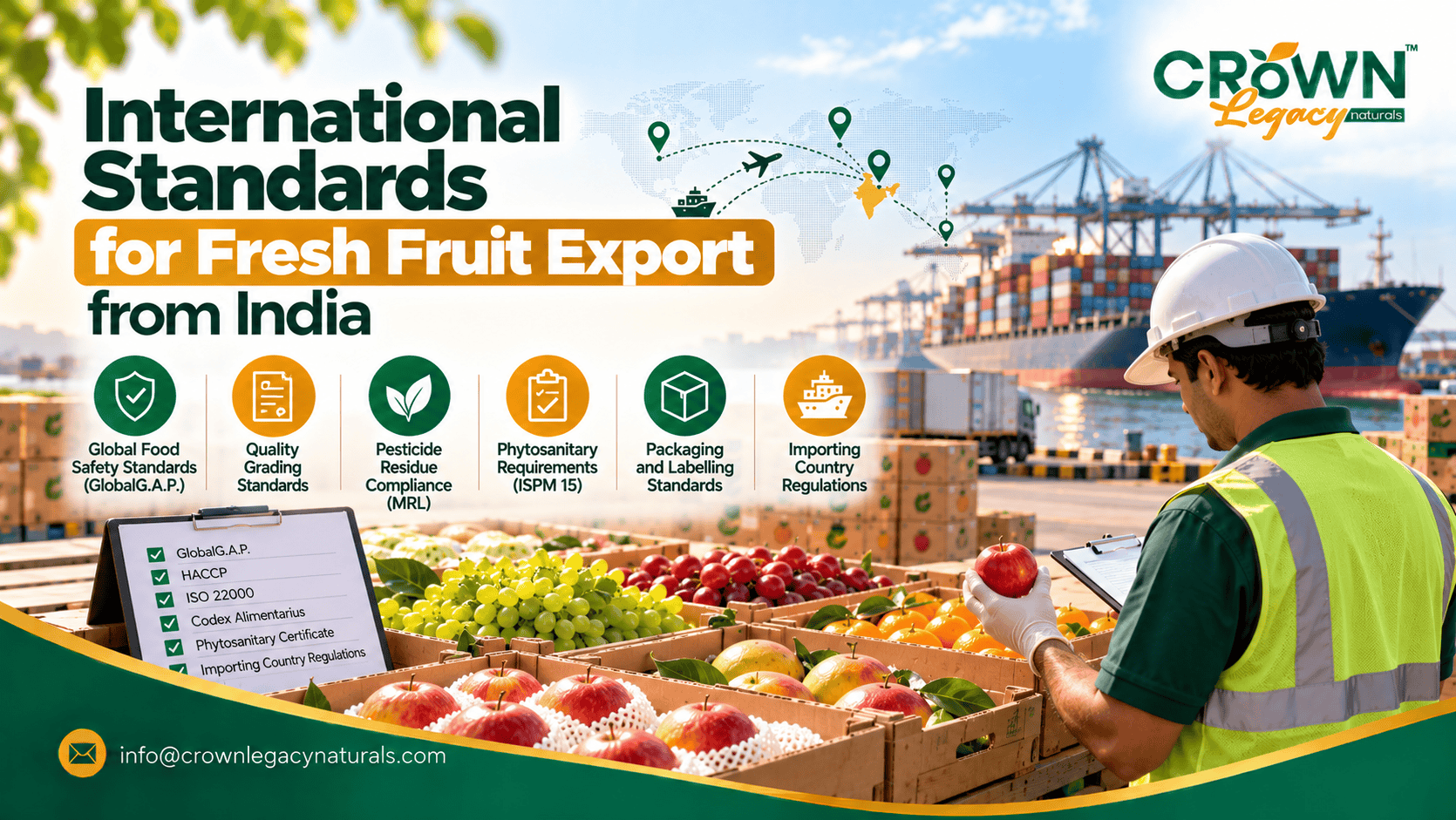
International standards for fresh fruit export from India help exporters and importers understand the quality, food safety, plant health, packaging, and documentation requirements that apply to cross-border shipments. The exact requirements depend on the fruit, destination country, and buyer specifications. Exporters should verify the applicable regulations before dispatch to reduce the risk of shipment delays, rejection, or additional compliance costs.
What Are International Standards for Fresh Fruit Export from India?
International standards for fresh fruit export from India are the rules, technical requirements, and buyer specifications that help determine whether fruit is suitable for a particular export market. These may cover produce quality, food safety, pesticide residues, plant health, packaging, labelling, traceability, and shipment documentation.
There is no single standard that applies identically to every fruit and destination. Requirements for mangoes entering one market may differ from those for grapes, bananas, pomegranates, guavas, or lychees entering another.
Exporters typically need to consider three broad areas:
- Official import requirements: Rules established by the destination country’s authorities.
- International plant health and food standards: Relevant frameworks and standards used in international trade.
- Buyer and commercial specifications: Agreed requirements for grade, size, maturity, packaging, shelf life, and other product characteristics.
Understanding these categories helps buyers and exporters separate mandatory legal requirements from additional commercial expectations.
What Are the Main Fresh Fruit Export Quality Standards?
Fresh fruit export quality standards help buyers assess whether produce meets agreed requirements for appearance, maturity, size, freshness, and condition. These standards may come from the importing country’s regulations, recognised commodity standards, sourcing fresh produce from India or the buyer’s own commercial specifications.
For Indian exporters, quality requirements should be defined before harvesting, grading, packing, and dispatch. The same fruit may be accepted under one buyer’s specification but rejected under another if size, maturity, or defect tolerances differ.
1. Appearance, Freshness, and Physical Condition
Export fruit should be assessed against the agreed requirements for appearance, firmness, colour, and visible defects. Buyers may specify acceptable limits for bruising, cuts, decay, shrivelling, and other conditions that affect marketability.
The criteria vary by fruit. For example, mangoes and bananas may have different maturity and colour requirements from grapes or pomegranates. Exporters should confirm the expected condition on arrival, not just the fruit’s appearance at packing.
2. Size, Weight, and Grading
Grading requirements help buyers receive fruit within a consistent size or weight range. Specifications may include fruit count per carton, individual fruit weight, diameter, or other measurements relevant to the commodity.
Before placing an order, buyers should agree on:
- Required grade and size category.
- Acceptable variation within each carton.
- Net weight or fruit count per package.
- Permitted visible defects.
- Packing format and presentation requirements.
Clear grading specifications reduce the risk of receiving produce that does not match the intended wholesale or retail market.
3. Maturity and Ripeness
Maturity standards help ensure that fruit is harvested and packed at a stage appropriate for its intended journey. Some fruits are transported at a mature but firm stage so they can ripen during distribution, while others require different maturity conditions.
The correct maturity assessment depends on the fruit and destination. Exporters should agree on the relevant indicators with the buyer and avoid relying on colour alone when other measurements or product-specific criteria are needed.
4. Freshness and Shelf-Life Expectations
Freshness requirements should account for the planned transit time, storage conditions, and distribution process. Buyers may specify that fruit must arrive in a condition suitable for further storage, ripening, wholesale distribution, or retail display.
Shelf life is influenced by harvest maturity, temperature, humidity, handling, and transport delays. Packaging and inspection can support quality management, but they cannot guarantee a particular shelf life under all conditions.
What Are the Fruit Export Regulations in India?
Fruit export regulations in India involve the applicable export procedures, documents required for fresh produce export, plant health controls, and any product- or destination-specific requirements. Exporters must identify the rules relevant to the fruit being shipped and the country receiving it instead of relying on a single checklist for every market.
The practical requirements may involve the following areas:
Area | What exporters should verify |
Export documentation | Commercial invoice, packing list, shipping documents, and other applicable paperwork |
Plant health | Phytosanitary certificate, inspection, treatment, or additional declarations where required |
Food safety | Applicable residue limits, testing, and hygiene requirements |
Product specifications | Buyer-agreed grade, maturity, size, and quality tolerances |
Packaging and labelling | Destination and buyer requirements for cartons, markings, and product information |
Traceability | Records connecting the produce to relevant sourcing, handling, and shipment details |
Market access | Whether the specific fruit is permitted and under what conditions in the destination market |
Not every requirement applies to every shipment. The relevant documents and procedures depend on the fruit, destination, and applicable rules.
What Packaging and Labelling Standards Should Fruit Exporters Follow?
Packaging and labelling requirements help protect fruit during transportation and provide buyers with the information needed to identify and handle a shipment. The specific requirements depend on the destination, fruit type, packaging format, and buyer contract.
1. Packaging Strength and Protection
Packaging should be appropriate for the fruit’s weight, size, fragility, and shipping conditions. Cartons, trays, dividers, and other protective materials may be selected to reduce movement and pressure during handling.
Importers should confirm carton dimensions, net weight, stacking requirements, ventilation, and moisture exposure where relevant. Packaging should also be compatible with the intended cooling and transport arrangements.
2. Labelling and Shipment Identification
Labels and carton markings may be required to identify the product, origin, packer or exporter, lot, quantity, or other information. Exact labelling requirements vary by market and product, so exporters should confirm the applicable rules before printing packaging.
Where traceability is required, labels and shipment records should help connect the packed goods to the relevant lot and supporting documentation.
3. Packaging Materials and Destination Rules
Exporters should verify any applicable destination requirements for packaging materials, food-contact suitability, and packaging components. Requirements may differ depending on the material and its intended use.
Buyers should confirm these details with their importer or compliance contact rather than assuming that a packaging format accepted in one market will automatically be accepted elsewhere.
What Should Buyers Check Before Importing Fresh Fruit from India?
Buyers should confirm the product specifications, destination requirements, documentation, and shipping arrangements before finalising a fresh fruit import order. A written checklist helps both parties establish expectations and identify missing information while there is still time to address it.
Use this checklist before dispatch:
- Confirm the fruit variety, grade, size, and maturity requirements.
- Agree on acceptable defects and quality tolerances.
- Verify whether the fruit is permitted for import into the destination market.
- Check applicable phytosanitary certificate and treatment requirements.
- Confirm food safety and pesticide residue requirements.
- Agree on packaging, carton weight, ventilation, and labelling.
- Establish which inspections or laboratory tests are required.
- Confirm shipment documents and traceability information.
- Review expected transit time and temperature-management arrangements.
- Verify that all required documentation is ready before dispatch.
This checklist is a planning aid, not a substitute for checking the current official rules for the particular fruit and destination.
How Crown Legacy Naturals Supports International Fruit Buyers?
Crown Legacy Naturals connects international buyers with fresh fruits and vegetables sourced from India. For importers, discussing the fruit variety, target market, quality expectations, packaging preferences, and documentation needs early can help clarify the requirements to address before an order is dispatched.
Buyers can share their preferred products, expected shipment quantities, and destination-market details during sourcing discussions. Product specifications and applicable export requirements should then be confirmed for the specific transaction.
This approach helps international buyers and suppliers align their expectations around produce selection, quality, packaging, and shipment preparation.
Conclusion
International standards for fresh fruit exporters from India cover several areas, including product quality, food safety, plant health, packaging, traceability, and documentation. The requirements vary by fruit and destination, so exporters should not assume that one set of rules applies to every international shipment.
Understanding fresh fruit export standards from India, fresh fruit export quality standards, fresh fruit export regulations, and fruit export regulations in India helps buyers and exporters prepare more effectively. Confirming the current requirements before dispatch can help reduce avoidable documentation gaps and shipment complications.
Crown Legacy Naturals helps international buyers explore fresh fruit sourcing options from India and discuss product, packing, and destination requirements as part of the purchasing process.