
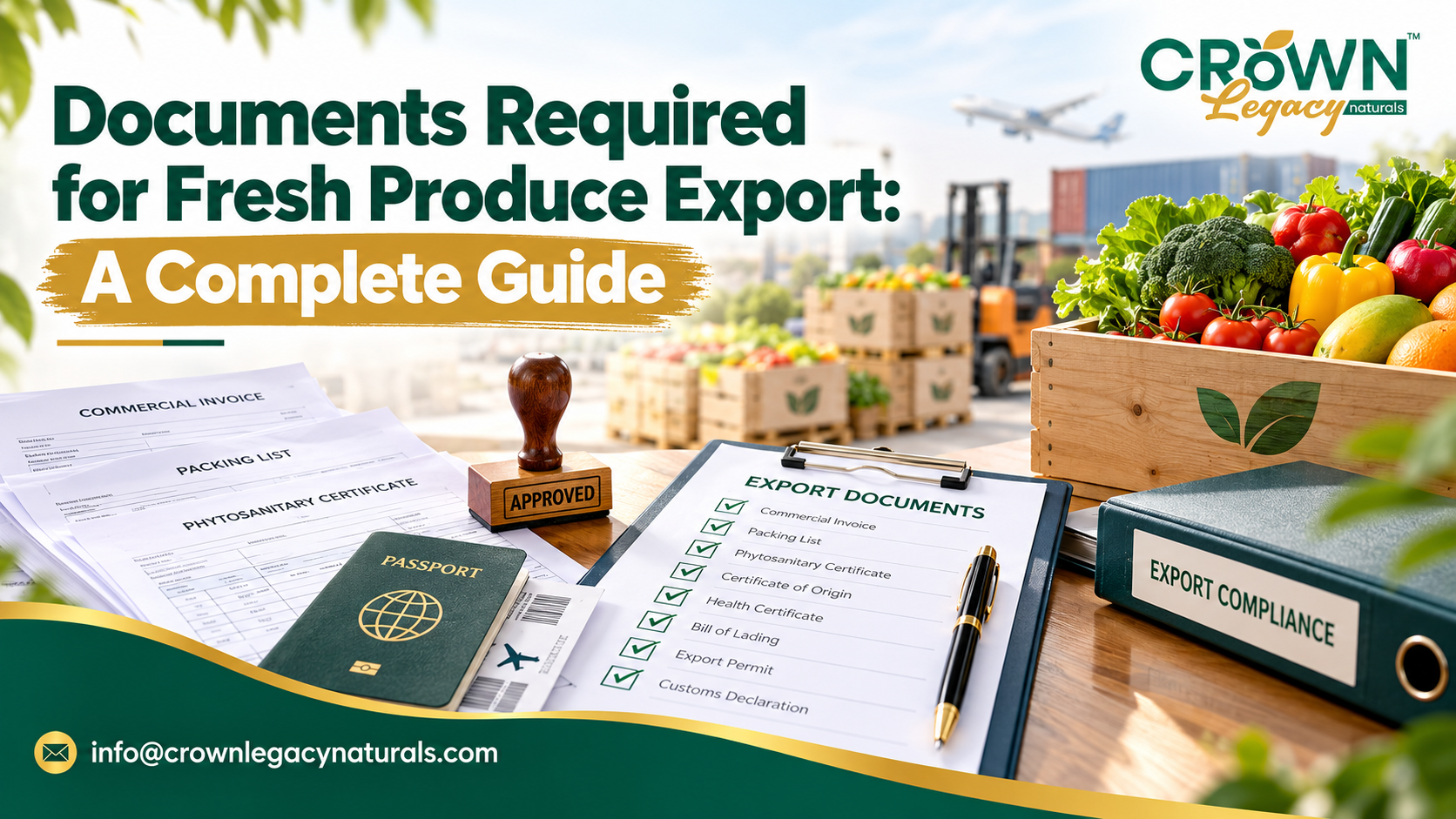
The documents required for fresh produce export typically include commercial, shipping, customs, origin, and product-specific certificates. For international buyers importing fruits and vegetables from India, understanding the required paperwork helps ensure the shipment meets export procedures and destination-country requirements while reducing avoidable documentation delays.
What Documents Are Required for Fresh Produce Export?
The documents required for fresh produce export can vary depending on the product, destination country, shipment method, and applicable regulations. However, a typical export shipment may involve:
- Commercial Invoice
- Packing List
- Certificate of Origin
- Phytosanitary Certificate
- Shipping or Transport Document
- Customs Export Documentation
- Purchase Order or Sales Contract
- Inspection or quality-related certificates, where required
- Import permits or other destination-country documents, where applicable
Not every shipment requires every document. International buyers and exporters should confirm the exact requirements for the specific fruit or vegetable and destination market before shipment.
Why Is Fresh Produce Export Documentation Important?
Fresh produce export documentation provides the information needed to identify the shipment, establish its commercial value, describe the products, and support customs and regulatory procedures.
Proper documentation helps different parties understand:
- What products are being shipped
- Who is exporting and importing them
- What quantity is included
- How the shipment is packaged
- Where the produce originated
- What the shipment is worth
- Which transportation method is being used
- Whether applicable plant-health requirements have been met
For fresh fruits and vegetables, accurate paperwork is particularly important because shipments are perishable and may be subject to destination-specific plant-health and food-safety requirements.
What Are the Main Fresh Produce Export Documents?
The following fresh produce export documents are commonly associated with international shipments from India.
1. Commercial Invoice
A commercial invoice provides the key commercial details of the transaction.
It generally includes information such as:
- Exporter details
- Buyer or importer details
- Product description
- Quantity
- Unit price
- Total value
- Currency
- Applicable trade terms
- Invoice number and date
The commercial invoice helps establish the commercial value of the shipment and supports customs procedures.
2. Packing List
A packing list explains how the products are physically packed for shipment.
It may include:
- Product description
- Number of cartons or packages
- Net weight
- Gross weight
- Package dimensions
- Packaging details
- Marks and numbers
The packing list helps the buyer, logistics providers, and customs authorities identify the contents of the shipment.
3. Certificate of Origin
A Certificate of Origin identifies the country from which the exported goods originate.
For Indian fresh produce shipments, this document may be required by the importing country or requested by the buyer for customs or trade-related purposes.
The exact requirements can depend on the destination market and applicable trade arrangements.
4. Phytosanitary Certificate
A phytosanitary certificate is an important document for many plant and plant-product shipments.
For fresh fruits and vegetables, the importing country may require evidence that the shipment meets applicable plant-health requirements.
The exact requirements can differ according to:
- Product
- Country of origin
- Destination country
- Plant-health regulations
- Import conditions
Therefore, buyers should confirm whether a phytosanitary certificate and any additional plant-health documentation are required for their particular shipment.
5. Shipping or Transport Document
The transportation document provides information about the movement of the shipment.
Depending on the mode of transportation, this may include documents such as:
- Bill of Lading for ocean freight
- Air Waybill for air freight
- Other applicable transport documents
The document contains shipment and transportation information needed by the relevant parties.
6. Customs Export Documentation
Customs documents for fresh produce export support the export declaration and customs clearance process.
The exact documentation can vary depending on the shipment and applicable Indian customs requirements.
Exporters need to ensure that the shipment information, product details, commercial value, and other required information are accurately declared.
What Are Customs Documents for Fresh Produce Export?
Customs documents for fresh produce export provide customs authorities with information needed to process an international shipment.
These may include commercial and shipment-related documentation such as:
- Commercial invoice
- Packing list
- Export declaration information
- Shipping documents
- Certificate of origin where required
- Product-specific certificates where applicable
The exact customs documentation depends on the shipment and the applicable procedures.
For buyers, it is important to understand which documents the exporter will provide and which documents the importer must arrange in the destination country.
Which Documents Come From the Exporter and Which May Be Needed by the Buyer?
One of the most important points in fresh produce export documentation is understanding responsibility.
Documentation Area | Typically Coordinated By |
Commercial Invoice | Exporter |
Packing List | Exporter |
Export-related documentation | Exporter |
Phytosanitary documentation | Exporter/competent authority, where applicable |
Shipping document | Exporter/logistics provider |
Certificate of Origin | Exporter/authorized issuing body, where required |
Import Permit | Buyer/importer, where required |
Destination customs documentation | Buyer/importer and customs representative |
Local import compliance | Buyer/importer |
Responsibilities can vary according to the transaction structure and agreed trade terms. Buyers should establish these responsibilities before confirming the vegetable shipment.
What Information Should Buyers Provide for Export Documentation?
International buyers can help the fruit exporter prepare accurate documentation by providing complete shipment information.
This may include:
- Buyer/importer legal name
- Complete billing and delivery address
- Destination country
- Destination port or airport
- Product requirements
- Quantity
- Packaging requirements
- Required import permits or certificates
- Any destination-specific labeling requirements
- Required delivery schedule
Providing accurate information early can help the exporter prepare the necessary fresh produce export documents more efficiently.
How Should Buyers Check Fresh Produce Export Documentation?
Before shipment, international buyers should review the documentation against the actual order.
Check the Product Details
Confirm that the fruit or vegetable name, variety, grade, quantity, and packaging details are correct.
Check Buyer and Exporter Details
Verify names, addresses, and other relevant company information.
Check Quantity and Weight
Compare the documentation with the agreed shipment quantity and packing information.
Check Destination Details
Make sure the destination, port, and consignee information are accurate.
Check Certificates
Confirm that required certificates are available and correspond to the relevant shipment.
Check Import Requirements
Verify that the documentation meets the destination country’s requirements before shipment.
This review is an important part of managing the documents required for fresh produce export.
What Can Happen If Export Documents Are Incorrect?
Incorrect or incomplete fresh produce export documents can create problems during shipment processing.
Potential issues can include:
- Customs processing delays
- Requests for additional information
- Problems with destination clearance
- Shipment delays
- Additional administrative work
- Difficulty matching documents with the physical shipment
Because fresh produce is perishable, documentation problems can be particularly inconvenient when they delay the movement or release of a shipment.
This is why buyers should review the documentation requirements before the shipment is dispatched.
How Crown Legacy Naturals Can Help with Fresh Produce Sourcing?
Crown Legacy Naturals connects international buyers with fresh fruits and vegetables sourced from India. When planning an import order, buyers can provide their product requirements, quantity, destination, packaging preferences, and applicable market requirements.
Having these details ready allows buyers and exporters to discuss the relevant fresh produce export documentation and shipment requirements before the order moves forward.
Conclusion
The documents required for fresh produce export depend on the product, destination country, shipment method, and applicable regulations. Commercial invoices, packing lists, certificates of origin, phytosanitary certificates, shipping documents, and customs documentation are among the key document categories buyers and exporters may need to consider.
Understanding fresh produce export documents, documents required for fruit export, documents required for vegetable export, and customs documents for fresh produce export helps international buyers prepare for the shipment and communicate documentation requirements clearly with their Indian exporter.
Crown Legacy Naturals helps international buyers explore fresh fruit and vegetable sourcing options from India while allowing buyers to discuss product, shipment, and destination requirements before placing an order.