
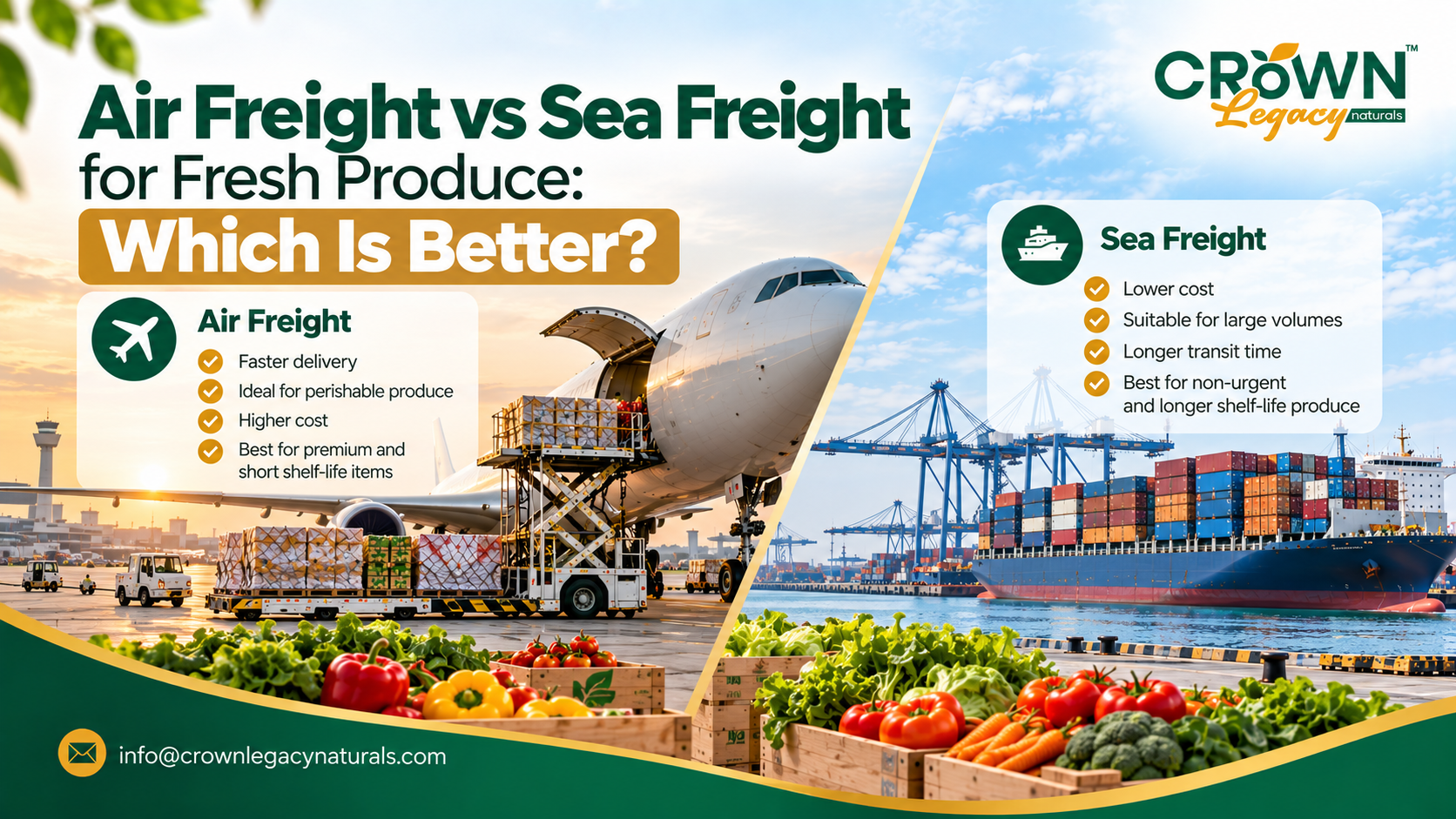
Air Freight vs Sea Freight for Fresh Produce depends on the product’s shelf life, shipment volume, destination, urgency, transportation cost, and handling requirements. Air freight generally offers faster transit and can suit highly time-sensitive produce, while sea freight is often more economical for larger shipments when the product can withstand longer transit times.
What Are the Main Fresh Produce Shipping Methods?
The main fresh produce shipping methods for international trade include air freight and sea freight. The appropriate option depends on what the buyer is shipping and how quickly it needs to arrive.
Air Freight
Air freight for fresh produce involves transporting fruits and vegetables by aircraft.
Its main advantage is speed. Shorter transit times can be useful for products with limited shelf life or buyers who need faster replenishment.
However, air transportation generally has a higher freight cost, particularly for heavier or larger shipments.
Sea Freight
Fresh produce sea freight involves transporting produce by vessel, usually in containers designed according to the product and shipment requirements.
Sea freight generally provides greater capacity and can be more economical for larger shipments. However, transit can take longer, making product selection, packaging, handling, and shipment planning particularly important.
Air Freight vs Sea Freight for Fresh Produce: What Is the Difference?
The key difference in Air Freight vs Sea Freight for Fresh Produce is the balance between transportation speed and shipment economics.
Factor | Air Freight | Sea Freight |
Transit time | Generally faster | Generally longer |
Freight cost | Usually higher | Often more economical for larger volumes |
Shipment volume | Better suited to smaller/time-sensitive shipments | Suitable for larger shipments |
Shelf life | Useful for highly time-sensitive produce | Better suited to products that can tolerate longer transit |
Planning | Faster replenishment possible | Requires greater transit planning |
Capacity | More limited compared with vessel transport | High capacity |
Handling | Requires appropriate airport/cargo handling | Requires appropriate container and port handling |
Best advantage | Speed | Cost efficiency and volume |
Neither method is universally better. The right choice depends on the buyer’s product and commercial requirements.
When Is Air Freight for Fresh Produce a Better Choice?
Air freight for fresh produce may be suitable when transit speed is a major priority.
Consider air freight when sourcing fresh produce from india:
- The produce has a relatively short commercial shelf life.
- The buyer needs rapid delivery.
- The shipment quantity is relatively small.
- The destination has suitable air cargo connectivity.
- The value of faster delivery justifies the higher freight cost.
- The buyer needs urgent replenishment.
For example, a buyer with a time-sensitive order may prioritize faster transportation even when the freight cost is higher.
However, faster transportation does not eliminate the need for suitable packaging, temperature management where applicable, documentation, and careful handling.
When Is Fresh Produce Sea Freight a Better Choice?
Fresh produce sea freight can be appropriate when shipment volume and transportation economics are important considerations.
Sea freight may be suitable when:
- The shipment involves larger quantities.
- The product can tolerate the expected transit time.
- Freight cost needs to be controlled.
- The destination has suitable port infrastructure.
- The shipment can be planned in advance.
- Appropriate transportation and handling conditions are available.
For large commercial shipments, sea transportation can provide substantial capacity compared with air cargo.
How Do Packaging and Handling Differ Between Air and Sea Freight?
The packaging strategy should reflect the selected transportation method and expected handling conditions.
For air freight for fresh produce, packaging may need to prioritize:
- Lightweight construction
- Product protection
- Efficient use of cargo space
- Appropriate ventilation
- Secure handling
For fresh produce sea freight, packaging needs to consider:
- Longer transit
- Stacking
- Container handling
- Ventilation where applicable
- Moisture conditions
- Product protection
The exact packaging requirements should be established for the specific fruit or vegetable and transportation route.
How Should Buyers Choose Between Air and Sea Freight?
The best approach to Air Freight vs Sea Freight for Fresh Produce is to compare the shipment against a defined set of criteria.
Choose Air Freight When:
- Speed is the highest priority.
- The product is highly time-sensitive.
- The shipment volume is relatively small.
- Faster replenishment has commercial value.
- The additional freight cost is acceptable.
Choose Sea Freight When:
- The shipment volume is large.
- The product can tolerate longer transit.
- Freight cost is a major consideration.
- The buyer can plan shipments in advance.
- Appropriate sea-freight infrastructure is available.
Consider Both Options When:
The buyer is uncertain about the most suitable method. In that case, compare actual transit time, product shelf life, volume, freight cost, destination handling, and expected arrival condition.
How Crown Legacy Naturals Can Support Fresh Produce Sourcing?
Crown Legacy Naturals connects international buyers with fresh fruits and vegetables sourced from India. Buyers can provide their product requirements, quantity, destination, preferred delivery schedule, and packaging specifications when discussing an order.
Understanding the available fresh produce shipping methods allows buyers to discuss transportation requirements with their exporter before finalizing the shipment.
Conclusion
Air Freight vs Sea Freight for Fresh Produce ultimately comes down to product shelf life, shipment volume, delivery urgency, transportation cost, destination, and expected arrival condition.
Air freight for fresh produce can be advantageous when speed is critical, while fresh produce sea freight can be more suitable for larger shipments where the product can withstand longer transit. Buyers should evaluate the complete logistics chain rather than comparing freight rates alone.
Crown Legacy Naturals helps international buyers explore fresh fruit and vegetable sourcing options from India based on their product, quantity, destination, and shipment requirements.