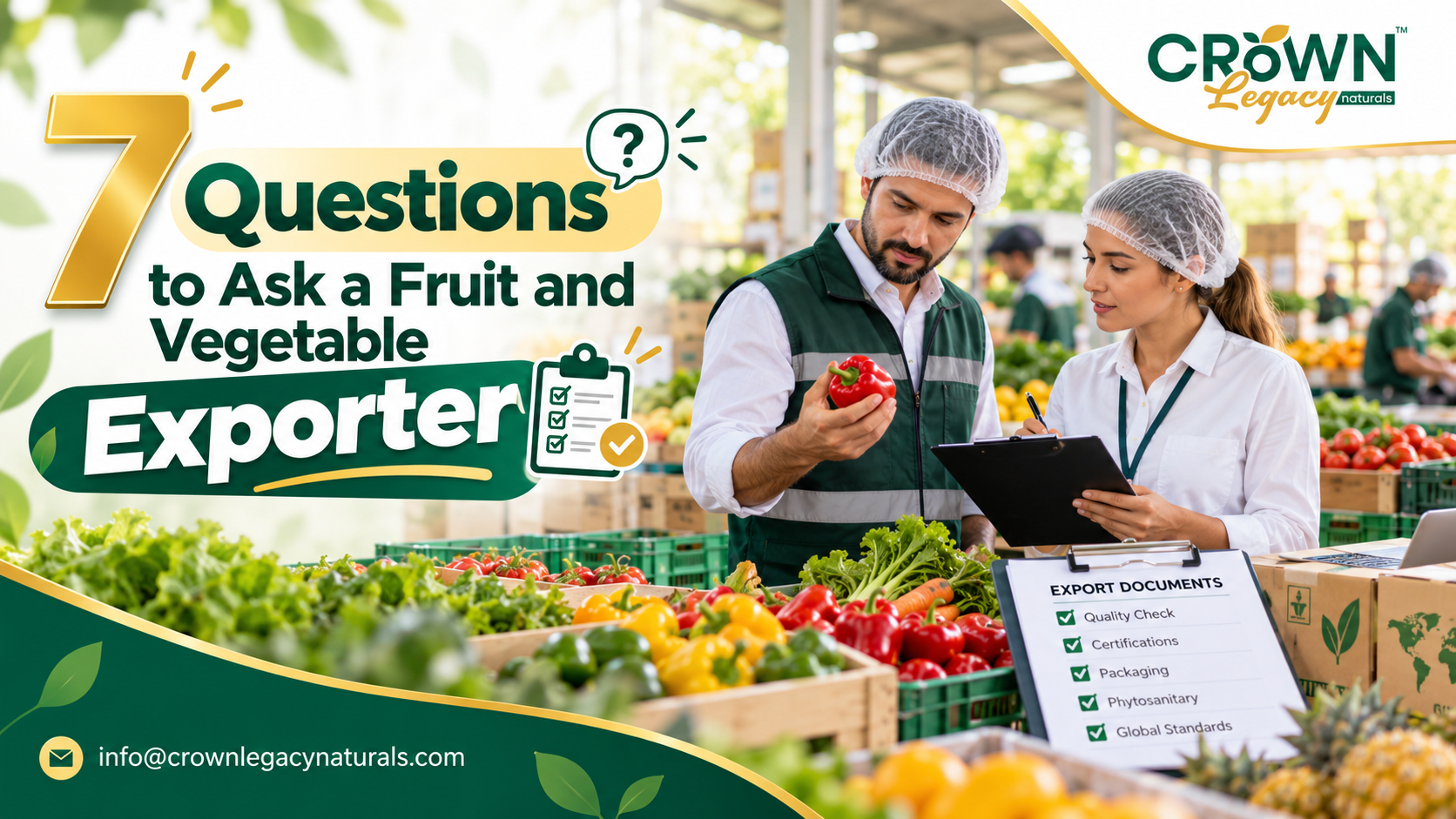
Before choosing a supplier, international buyers should know the right questions to ask a fruit and vegetable exporter about product quality, sourcing, supply capacity, certifications, pricing, packaging, and export experience. Asking these questions before placing an order helps buyers compare suppliers, verify their capabilities, and determine whether an exporter can meet their specific fresh produce requirements.
Why Buyers Should Ask Questions Before Choosing an Exporter?
Asking the right questions helps buyers understand what an exporter can actually provide rather than relying only on product listings or promotional claims.
A supplier may offer the fruit or vegetables you need, but that does not necessarily mean it can consistently provide your required grade, quantity, packaging, or specifications.
The right questions can help buyers:
- Verify the exporter’s experience
- Understand product specifications
- Check sourcing capabilities
- Assess quality-control practices
- Confirm supply capacity
- Compare commercial terms
- Understand seasonal availability
- Evaluate long-term suitability
These checks are particularly important when establishing a new international supply relationship.
What Are the 7 Questions to Ask a Fruit and Vegetable Exporter?
The seven most important questions cover product specifications, sourcing, quality, supply capacity, certifications, commercial terms, and export experience.
1. Which Fruits and Vegetables Do You Export and What Specifications Are Available?
Start by asking exactly which products the exporter supplies and what specifications are available.
This is one of the most important questions to ask a fruit and vegetable exporter because a general product listing does not tell you whether the company can provide the exact variety, grade, size, or quality you require.
Ask about:
- Fruit or vegetable variety
- Grade
- Size
- Average weight
- Quality specifications
- Seasonal availability
- Packaging options
- Minimum order quantity
For example, if you are sourcing mangoes, ask which varieties and grades are available rather than simply asking whether the exporter supplies mangoes.
Similarly, vegetable buyers should clarify the exact variety, size, grade, and packaging of products such as okra, green chillies, drumstick, or other vegetables.
Clear specifications allow buyers to compare suppliers on a like-for-like basis.
2. Where Do You Source Your Fruits and Vegetables?
The second question should focus on sourcing.
Understanding where and how the fruit exporter obtains its products can help buyers assess supply consistency and product availability.
Ask:
- Which regions do you source from?
- Do you work directly with farmers?
- Do you have established grower networks?
- Which regions supply each product?
- How do you manage seasonal availability?
- Can you maintain recurring supply?
A supplier with a structured sourcing network may be better positioned to handle recurring requirements than a company that sources products only when an order is received.
This question is especially important for buyers who need consistent quantities throughout a defined purchasing period.
3. How Do You Check the Quality of Your Produce Before Exporting?
Quality should be discussed before agreeing to an order.
Buyers should ask how the vegetable exporter checks products before they are packed and prepared for shipment.
Important areas include:
- Freshness
- Size
- Grade
- Appearance
- Firmness
- Colour
- Uniformity
- Defect tolerance
- Weight
- Packaging condition
When buyers evaluate a fruit exporter, they should look for specific quality procedures rather than relying on general statements such as “premium quality.”
The same applies when buyers evaluate a vegetable exporter. Ask how vegetables are selected, graded, inspected, and prepared before shipment.
4. What Quantity Can You Supply Consistently?
An exporter may be able to fulfil a single order but may not have the sourcing capacity required for recurring or larger shipments.
Therefore, buyers should ask about both current availability and regular supply capacity.
Ask:
- What is your minimum order quantity?
- How much can you supply per shipment?
- What quantity can you supply regularly?
- Can supply increase during peak demand?
- What happens during the off-season?
- Which products have the most consistent availability?
For wholesalers, distributors, retailers, and foodservice businesses, this question is particularly important because supply requirements often continue beyond the first shipment.
The answer can help determine whether the exporter is suitable for a one-time purchase or a longer-term sourcing relationship.
5. Which Certifications and Export Standards Do You Meet?
Certifications and relevant standards can provide useful information when assessing a potential supplier.
However, buyers should not simply count the number of certifications listed on an exporter’s website.
Instead, ask:
- Which certifications do you currently hold?
- Are they valid and current?
- Which products or facilities do they cover?
- Are they relevant to my destination market?
- Can supporting documentation be provided?
The requirements can vary depending on the product, destination country, buyer specifications, and applicable regulations.
For buyers who want to evaluate a fruit exporter or evaluate a vegetable exporter, certifications should therefore be considered alongside product quality, sourcing, supply capacity, and export experience.
6. What Are Your Pricing, Packaging, and Commercial Terms?
Price is important, but buyers should understand exactly what they are comparing.
One of the key questions to ask a fruit and vegetable exporter is what the quoted price includes.
Ask about:
- Price per kg, carton, or agreed unit
- Fruit or vegetable grade
- Packaging format
- Quantity per carton
- Minimum order quantity
- Payment terms
- Shipping terms
- Other applicable costs
Two suppliers may quote different prices because they offer different grades, packaging, quantities, or commercial terms.
Therefore, buyers should compare quotations only after confirming that the product specifications are equivalent.
7. Which International Markets Do You Currently Supply?
The final question should establish whether the exporter has relevant international market experience.
Ask:
- Which countries do you currently export to?
- Which fruits and vegetables do you regularly ship?
- What types of buyers do you serve?
- Do you handle recurring international orders?
- Are you familiar with destination-specific buyer requirements?
This does not mean an exporter without experience in your particular country is automatically unsuitable. Instead, the information helps you understand the supplier’s existing international experience and determine what additional verification may be needed.
For an importer, wholesaler, distributor, or retailer, relevant export experience can provide useful context when comparing potential suppliers.
What Questions Should You Ask a Fruit Exporter Specifically?
Beyond the general questions to ask a fruit and vegetable exporter, fruit buyers should ask product-specific questions about variety, maturity, grade, size, seasonal availability, and expected quality.
Useful questions to ask a fruit exporter include:
- Which varieties are available?
- What fruit grades do you supply?
- What sizes are available?
- What is the normal supply season?
- What quality specifications do you follow?
- What quantities can you supply?
- What packaging options are available?
- Can you provide samples?
- Which international markets do you currently supply?
These questions help buyers determine whether the exporter can supply the specific fruit requirements of their market.
What Questions Should You Ask a Vegetable Exporter Specifically?
The questions to ask a vegetable exporter should focus on variety, size, freshness, grade, sourcing region, seasonal availability, and consistency.
Buyers can ask:
- Which vegetable varieties do you supply?
- What sizes and grades are available?
- Where are the vegetables sourced?
- What is the seasonal availability?
- How is quality checked?
- What quantities can you supply?
- What packaging formats are available?
- Can you provide samples?
- Which international markets do you serve?
These questions help buyers understand whether the exporter has the sourcing network and supply capacity required for their specific vegetables.
This approach makes it easier to distinguish between an exporter that simply lists products and one that can potentially support your sourcing requirements.
How Can Buyers Evaluate a Fruit Exporter Before Placing an Order?
To evaluate a fruit exporter, buyers should verify the information provided during the initial discussion.
Start by checking whether the exporter:
- Provides clear fruit specifications
- Explains its sourcing regions
- Can discuss seasonal availability
- Has relevant export experience
- Can explain its quality-control process
- Provides transparent pricing
- Can supply the required quantity
- Can provide samples where appropriate
A sample or trial order can also help buyers compare the actual product against the agreed specifications before committing to larger recurring orders.
How Can Buyers Evaluate a Vegetable Exporter Before Placing an Order?
To evaluate a vegetable exporter, buyers should use the same structured approach while giving additional attention to freshness, size, grade, seasonal supply, and product consistency.
Check:
- Product variety
- Grade and size
- Sourcing region
- Seasonal availability
- Quality-control process
- Supply capacity
- Packaging
- Pricing
- Export experience
- Sample quality
This helps buyers determine whether the exporter can meet their requirements consistently rather than only fulfilling an initial order.
Should Buyers Request Samples Before Choosing an Exporter?
Where practical, buyers should consider requesting samples before committing to a large order.
A sample can help buyers assess whether the actual product matches the information provided by the exporter.
Check:
- Freshness
- Size
- Grade
- Appearance
- Uniformity
- Packaging
- Product presentation
For international buyers, sample evaluation can be particularly useful when establishing a relationship with a new supplier.
What Should Buyers Do After Asking These 7 Questions?
After asking the questions to ask a fruit and vegetable exporter, buyers should compare the responses against their specific purchasing requirements.
A practical next step is to:
- Shortlist suitable exporters.
- Compare product specifications.
- Verify sourcing capabilities.
- Review quality standards.
- Compare equivalent quotations.
- Request samples where appropriate.
- Confirm supply capacity.
- Clarify commercial requirements.
- Evaluate the initial order.
- Consider recurring supply if the exporter meets expectations.
The purpose is not simply to find the cheapest supplier. It is to identify an exporter whose products, capabilities, and supply model match your business requirements.
How Can Crown Legacy Naturals Help Buyers Source Fresh Produce?
Crown Legacy Naturals sources fresh fruits and vegetables from India for international buyers.
For businesses looking to establish a fresh produce supply relationship, buyers can discuss their required fruits or vegetables, quantities, destination market, specifications, and purchasing requirements.
The same questions outlined in this guide can be used when evaluating Crown Legacy Naturals or comparing any potential produce exporter.
Conclusion
The right questions to ask a fruit and vegetable exporter should help buyers understand the supplier’s products, sourcing network, quality process, supply capacity, certifications, commercial terms, and international experience. Asking these questions before placing an order allows buyers to compare exporters based on relevant information rather than relying only on price or promotional claims.
Crown Legacy Naturals provides international buyers with access to fresh fruits and vegetables sourced from India. Buyers can use these seven questions to assess their requirements, compare potential suppliers, and determine whether Crown Legacy Naturals is a suitable sourcing partner for their fresh produce needs.