
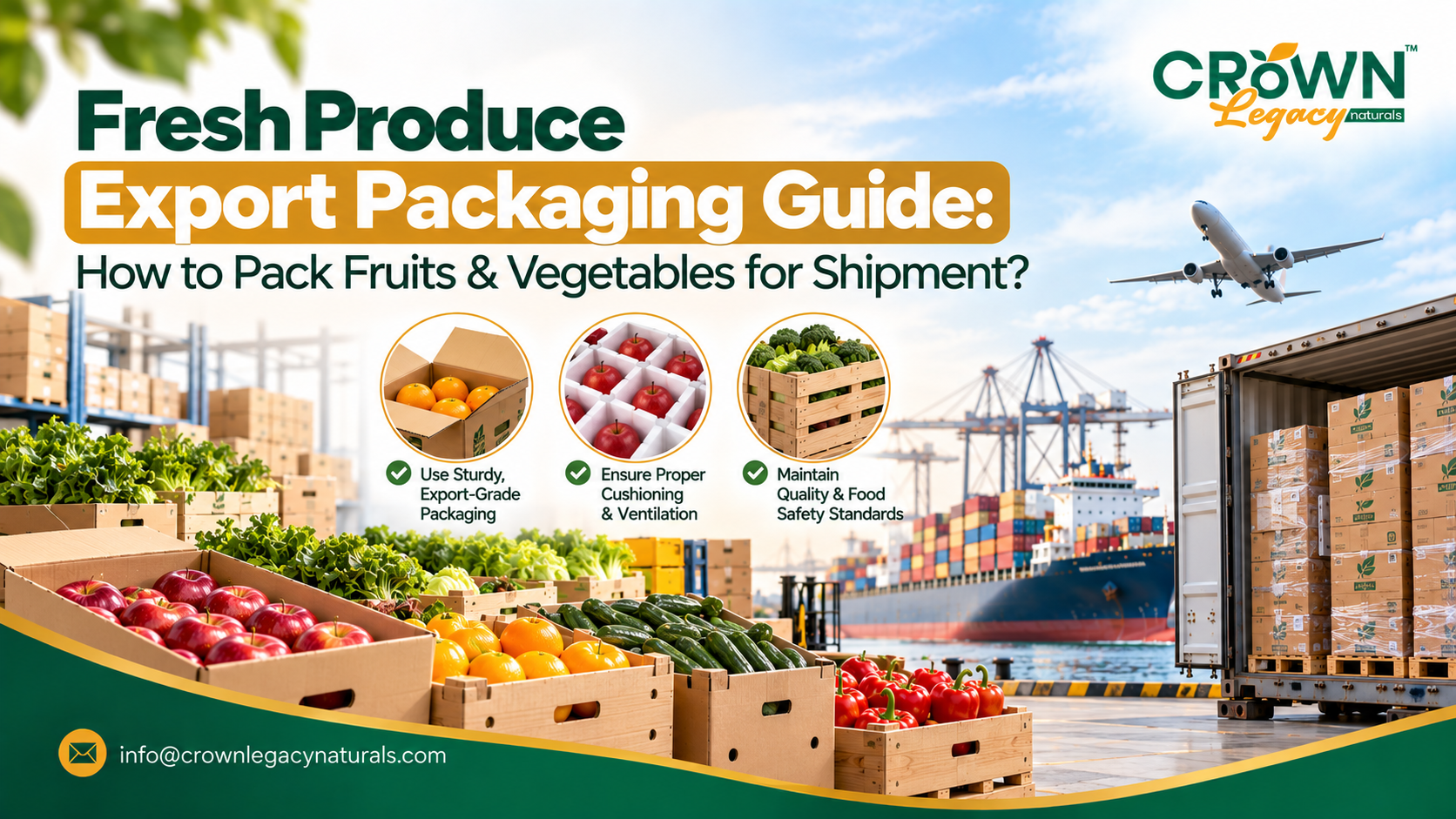
A Fresh Produce Export Packaging Guide helps international buyers and exporters understand how fruits and vegetables should be packed for safe international transportation. Effective export packaging should protect produce from physical damage, support ventilation and handling, maintain product quality, provide suitable labeling, and meet applicable destination and buyer requirements.
What Is a Fresh Produce Export Packaging Guide?
A Fresh Produce Export Packaging Guide explains the packaging considerations involved in preparing fresh fruits and vegetables export from India for international shipment.
Unlike shelf-stable products, fresh produce can be affected by:
- Rough handling
- Compression
- Temperature changes
- Moisture
- Excess humidity
- Poor ventilation
- Extended transit
- Inappropriate packaging materials
Therefore, packaging needs to be selected according to the product, transportation method, expected transit conditions, and buyer requirements.
Why Is Packaging Important for Fresh Produce Exports?
The right packaging helps protect fruits and vegetables throughout handling, transportation, storage, and delivery.
Good export packaging can help:
- Reduce physical damage
- Protect produce from contamination
- Support ventilation
- Maintain package integrity
- Make handling easier
- Organize products by quantity and grade
- Support identification and traceability
- Meet buyer and destination requirements
The objective of packaging fruits and vegetables for export is not simply to place produce inside a container. The packaging should be appropriate for the characteristics of the specific product and its expected journey.
What Should Fresh Produce Export Packaging Include?
A practical Fresh Produce Export Packaging Guide should consider five key areas:
- Product protection — Prevent bruising, crushing, cuts, and other physical damage.
- Ventilation — Allow suitable airflow where required.
- Moisture management — Reduce packaging-related moisture problems.
- Handling — Make cartons, crates, or other packages suitable for loading and unloading.
- Identification — Include applicable product and shipment information.
The exact combination depends on the fruit or vegetable and the shipment requirements.
How Should Fruits and Vegetables Be Prepared Before Packaging?
Packaging should begin only after the produce has been properly prepared according to the agreed specifications as per documents required for fresh produce export.
Before packing, check:
- Correct fruit or vegetable variety
- Required grade
- Appropriate maturity
- Acceptable size
- Freshness
- Cleanliness
- Physical condition
- Absence of unacceptable damage or deterioration
Using appropriate produce in the first place makes the packaging process more effective.
A damaged or unsuitable product should not be relied upon to become export-ready simply because it is placed in good packaging.
What Materials Are Used for Fresh Produce Export Packaging?
The appropriate packaging material depends on the product, shipment method, handling requirements, and buyer specifications.
Common options can include:
Corrugated Cartons
Corrugated cartons are commonly used for many fresh produce shipments because they are relatively lightweight, stackable, and can be designed with ventilation openings.
Plastic Crates
Reusable or durable plastic crates can provide structural support and ventilation for certain products and supply chains.
Wooden or Rigid Containers
Certain products may require stronger packaging structures depending on weight, handling, or transportation requirements.
Produce Bags and Liners
Bags, liners, or other internal packaging components may be used where appropriate for the product and shipment requirements.
The packaging material should be selected based on the produce rather than using one packaging format for every product.
How Does Fruit Export Packaging Work?
Fruit export packaging should protect the reliable fruit exporter from bruising, compression, impact, moisture-related issues, and excessive movement during transportation.
The packaging process generally involves:
- Sorting fruit according to the agreed specifications.
- Removing produce that does not meet the required quality.
- Selecting an appropriate package size and material.
- Arranging fruit to minimize unnecessary movement.
- Providing suitable ventilation where required.
- Securing the package for handling and transportation.
- Applying required labels and shipment information.
- Checking the final package before dispatch.
The exact approach should be adapted to the fruit because different fruits have different firmness, size, maturity, and handling characteristics.
What Are the Key Fresh Produce Export Packaging Standards?
Fresh produce export packaging standards can vary according to the product, destination country, buyer requirements, transportation method, and applicable regulations. Therefore, following the fruit and vegetable export process from India is very much important.
Before shipment, buyers and exporters should consider:
- Packaging material requirements
- Package size and weight
- Ventilation requirements
- Labeling requirements
- Product identification
- Country-of-origin information
- Handling instructions where applicable
- Packaging hygiene
- Destination-specific requirements
- Transportation and stacking conditions
The exporter should confirm the requirements applicable to the specific shipment instead of assuming that one packaging standard applies universally.
How Should Fresh Fruits and Vegetables Be Packaged for Export?
Fresh vegetable packaging for export should be designed around the vegetable’s size, shape, firmness, moisture characteristics, weight, and expected transportation conditions.
Before packing vegetables, consider:
Size and Weight
The package should be able to hold the intended quantity without excessive compression.
Ventilation
Suitable ventilation can be important for maintaining appropriate conditions during transportation.
Protection
The packaging should help reduce bruising, cuts, crushing, and other physical damage.
Moisture
Packaging should be selected with consideration for the product’s moisture characteristics and expected transportation environment.
Handling
Packages should be practical for loading, unloading, stacking, and transportation.
Apply Required Labels
Add the applicable product, origin, quantity, handling, and shipment information.
The exact requirements for fresh vegetable packaging for export should be established for each product.
What Should Be Included on Fresh Produce Export Packaging?
Packaging labels should follow the applicable buyer, regulatory, and destination-market requirements.
Depending on the shipment, packaging information may include:
- Product name
- Variety
- Grade
- Net weight
- Quantity
- Country of origin
- Exporter information
- Lot or batch identification
- Packing date where required
- Handling information where applicable
The exact labeling requirements should be confirmed for the destination country and product.
How Can Buyers Check Fresh Produce Export Packaging?
International buyers should confirm packaging requirements before placing or finalizing an order.
A buyer can check:
Package Type
Is the proposed carton, crate, bag, or other package suitable for the product?
Package Size
Does the package match the required quantity and weight?
Protection
Will the packaging provide sufficient protection during expected handling and transit?
Ventilation
Does the package provide appropriate airflow where needed?
Labeling
Does the package contain the information required by the buyer and destination market?
Transportation
Is the packaging suitable for the planned shipping method and expected handling conditions?
These checks can help buyers avoid packaging mismatches before the shipment is prepared.
How Can Crown Legacy Naturals Help International Buyers?
Crown Legacy Naturals connects international buyers with fresh fruits and vegetables sourced from India. Buyers can communicate their preferred product, quantity, packaging format, destination, and quality requirements when discussing a potential shipment.
A clear packaging specification helps both the buyer and exporter establish expectations before the produce is packed and dispatched.
Conclusion
A Fresh Produce Export Packaging Guide helps international buyers understand the key packaging factors that should be considered before shipping fruits and vegetables internationally. Product protection, ventilation, package strength, quantity, labeling, handling, and destination requirements all need to be evaluated according to the specific produce.
Whether reviewing fruit export packaging, fresh vegetable packaging for export, or requirements for packaging fruits and vegetables for export, buyers should establish packaging specifications before confirming an order.
Crown Legacy Naturals helps international buyers explore fresh fruit and vegetable sourcing options from India while allowing product, packaging, quantity, and destination requirements to be discussed before shipment.