
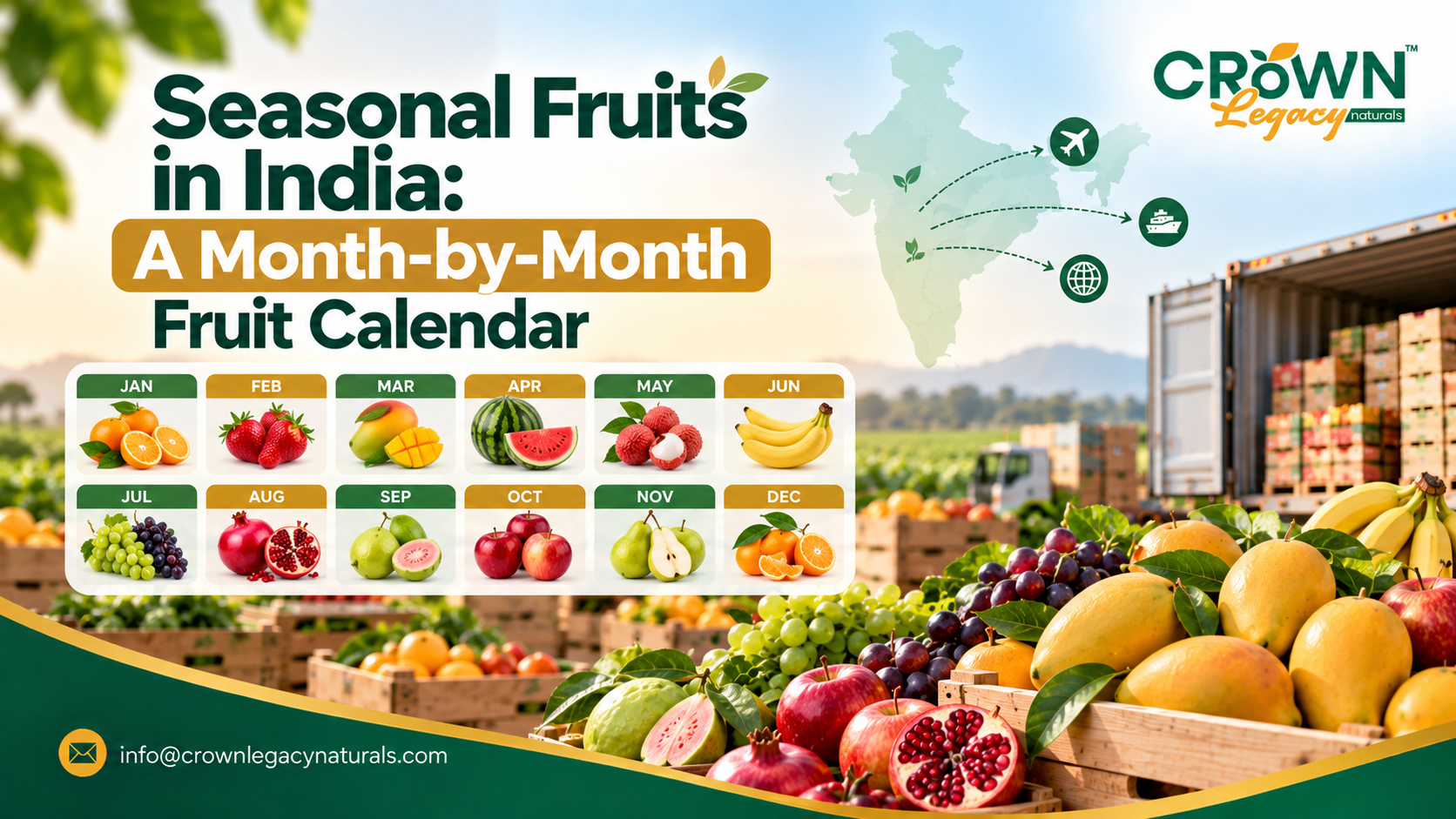
Seasonal Fruits in India vary throughout the year because of India’s diverse climate, growing regions, and crop cycles. Mangoes, watermelons, and lychees are commonly associated with warmer months, while oranges, guavas, and strawberries are more prominent during cooler periods. For international buyers, understanding these seasonal patterns helps with sourcing and shipment planning.
What Are Seasonal Fruits in India?
Seasonal fruits in India are fruits that naturally become available during particular periods of the year based on seasonal import calendar, growing conditions, regional climate, flowering, harvesting, and crop cycles.
India’s diverse agricultural regions allow different fruits to become available at different times. As a result, fruit availability can overlap between seasons, and harvesting periods may differ by state and variety.
For buyers sourcing from India, seasonality is important because it can influence:
- Product availability
- Variety selection
- Harvest timing
- Sourcing regions
- Order planning
- Export schedules
- Expected supply windows
Indian Seasonal Fruits: Month-by-Month Calendar
The following seasonal fruit calendar India provides a general guide to when commonly grown Indian fruits are typically available.
Month | Common Seasonal Fruits in India |
January | Orange, guava, strawberry, papaya, pomegranate |
February | Orange, guava, strawberry, papaya, pomegranate |
March | Mango, watermelon, muskmelon, papaya, pineapple |
April | Mango, watermelon, muskmelon, pineapple, papaya |
May | Mango, watermelon, muskmelon, lychee, pineapple |
June | Mango, lychee, watermelon, jamun, papaya |
July | Jamun, lychee, papaya, peach, plum |
August | Peach, plum, pear, pomegranate, papaya |
September | Pomegranate, apple, pear, guava, papaya |
October | Pomegranate, apple, guava, papaya, orange |
November | Orange, guava, pomegranate, apple, strawberry |
December | Orange, guava, pomegranate, strawberry, apple |
This seasonal fruit calendar India is a general reference. Actual availability can vary by region, variety, weather conditions, harvest timing, and farming practices.
What Are the Main Summer Fruits in India?
Summer fruits in India are generally associated with India’s warmer months, particularly from March through June, although availability can vary by region.
Common examples include:
- Mango
- Watermelon
- Muskmelon
- Lychee
- Jamun
- Pineapple
Mango is one of the most commercially important summer fruits, with multiple varieties grown in different parts of India.
Watermelon and muskmelon are also strongly associated with warmer weather, while lychee and jamun have more specific seasonal windows.
What Are the Main Winter Fruits in India?
Winter fruits in India are generally associated with the cooler months, especially from November through February.
Common examples include:
- Orange
- Guava
- Strawberry
- Pomegranate
- Apple
Some fruits export can be available outside these broad periods depending on location, cultivation conditions, variety, and production practices.
What Are the Main Monsoon Fruits in India?
Monsoon fruits in India include fruits that are commonly harvested or available during the rainy-season period.
Examples include:
- Jamun
- Lychee
- Peach
- Plum
- Pear
- Papaya
Monsoon fruit availability can differ significantly between growing regions. Buyers should therefore confirm the expected harvest window before placing a commercial order.
What Are the Main Spring Fruits in India?
Spring fruits in India generally represent a transition between India’s cooler and warmer fruit seasons.
Depending on the region and year, fruits available during the spring period can include:
- Strawberry
- Papaya
- Pineapple
- Early mango varieties
- Watermelon
- Muskmelon
March and early April can be particularly important transition months in the seasonal fruit calendar India.
Why Does Fruit Seasonality Matter to International Buyers?
Understanding Indian seasonal fruits is important when planning international sourcing because the availability of a fruit is directly connected to its growing and harvesting cycle.
Buyers should consider:
Harvest Timing
Knowing the expected harvest period helps buyers plan orders in advance.
Product Availability
A fruit may have a limited commercial supply window, making early sourcing discussions useful.
Variety
Different varieties of the same fruit can have different harvesting periods.
Sourcing Region
India’s diverse agricultural regions can have different production calendars.
Shipping Schedule
The expected harvest date needs to be considered alongside packing, transportation, customs clearance, and final delivery.
Does Fruit Availability Vary Across India?
Yes. The availability of Indian seasonal fruits can vary between regions because India has multiple climate zones and growing conditions.
Factors that can influence availability include:
- Location
- Climate
- Variety
- Weather conditions
- Rainfall
- Harvest timing
- Farming practices
- Crop conditions
For example, the same fruit may become available at different times in different production regions. Therefore, a national fruit calendar should be treated as a general guide rather than an exact harvest schedule.
How Should International Buyers Plan Seasonal Fruit Orders?
Buyers should begin planning before the expected harvest period rather than waiting until the fruit is ready for immediate shipment.
A seasonal sourcing plan can include:
Planning Stage | Buyer Action |
1. Identify fruit | Select products and varieties |
2. Check season | Review expected Indian harvest window |
3. Contact exporter | Discuss availability in advance |
4. Define specifications | Confirm grade, size and quality |
5. Confirm quantity | Estimate required order volume |
6. Plan packaging | Agree on packaging requirements |
7. Plan shipping | Consider transportation and transit |
8. Confirm order | Finalize based on actual availability |
Planning ahead is particularly useful for fruits with relatively short or concentrated harvest windows.
How Crown Legacy Naturals Helps Buyers Source Indian Seasonal Fruits?
Crown Legacy Naturals connects international buyers with fresh fruits and vegetables sourced from India. Buyers can share their required fruit, variety, quantity, destination, quality specifications, and expected purchasing schedule when discussing seasonal sourcing.
Understanding Indian seasonal fruits can help buyers approach sourcing discussions earlier and align their purchasing plans with expected Indian harvest periods.
Conclusion
Seasonal Fruits in India follow different harvest cycles throughout the year, with mangoes, watermelons, muskmelons, and lychees commonly associated with warmer months, while oranges, guavas, strawberries, and pomegranates are more prominent during cooler periods.
The seasonal fruit calendar India provides a useful starting point for international buyers, but actual availability can vary by fruit variety, growing region, weather, and harvest conditions. Buyers should confirm current availability and expected supply windows before finalizing an order.
Crown Legacy Naturals helps international buyers explore fresh fruit sourcing options from India based on their preferred products, varieties, quantities, destinations, and seasonal requirements.