
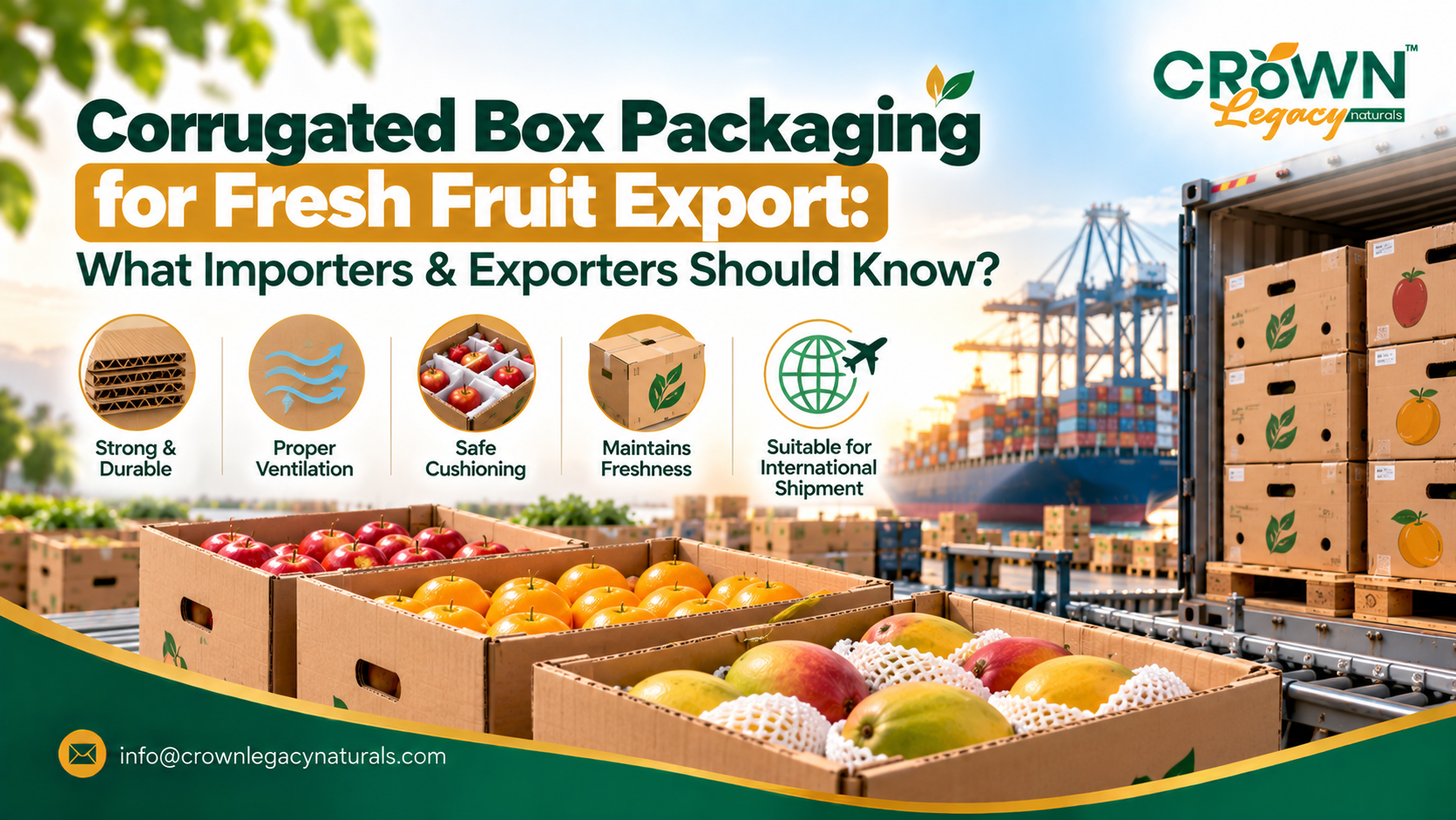
Corrugated box packaging for fresh fruit export helps protect produce during handling, transportation, storage, and international shipping. The right packaging depends on the fruit type, weight, moisture exposure, ventilation needs, stacking conditions, and shipping method. Importers should assess box strength, dimensions, ventilation, and destination requirements before confirming packaging specifications with an exporter.
What Is Corrugated Box Packaging for Fresh Fruit Export?
Corrugated box packaging for fresh fruit export uses paper-based boxes made from layers of linerboard and fluted paper. The fluted middle layer adds cushioning and structural support, while the outer liners provide a surface for printing and handling. These boxes are widely used for fresh produce because their design can be adapted to different fruit sizes, packing configurations, and transport conditions.
Unlike ordinary cartons, fresh produce export packaging must be selected with the full shipping journey in mind. Fruit may pass through packing facilities, cold storage, loading areas, ports, distribution centres, and retail warehouses before reaching its final destination.
Common components of corrugated fruit boxes include:
- Outer liner: Provides the external surface and contributes to box strength.
- Fluted medium: Adds rigidity and cushioning between the liner layers.
- Inner liner: Creates the inside surface that holds the packed fruit.
- Ventilation openings: Allow airflow when required by the fruit and storage conditions.
- Printing and labels: Display product information, handling instructions, and shipment details where applicable.
For importers, understanding these components helps when comparing packaging options from different fresh produce exporters.
Why Are Corrugated Boxes for Fruit Export Important?
Corrugated boxes for fruit export help reduce the risk of bruising, crushing, and handling damage when the packaging is correctly designed for the product and shipment. They also support organised packing, pallet stacking, storage, and transportation. However, packaging alone cannot prevent spoilage caused by unsuitable temperatures, poor handling, excessive moisture, or delays in the supply chain.
The main benefits of properly selected fruit export cartons include:
1. Protection During Handling and Transportation
Fresh fruits can be vulnerable to pressure, vibration, and impact. Packaging that matches the fruit’s weight, size, and firmness helps reduce movement inside the carton and provides support during loading and unloading.
For delicate fruits, importers should consider internal dividers, trays, or other suitable inserts where needed. The packaging design should prevent excessive movement without placing unnecessary pressure on the produce.
2. Better Stacking and Storage Support
Export shipments are often stacked on pallets or inside shipping containers. If cartons lack sufficient compression strength, lower boxes may deform under the weight of those above them.
Appropriate corrugated construction and carton dimensions can help maintain stack stability. Importers should assess the expected stacking height, shipment weight, storage duration, and moisture conditions before approving the packaging.
3. Ventilation for Fresh Produce
Some fruits require airflow around the packed produce to support temperature management during storage and transportation. Ventilation openings may help air circulate through the cartons, depending on the packaging arrangement and cooling system.
However, adding more holes does not automatically improve packaging performance. Ventilation openings can reduce the strength of a carton, so their number, size, and placement should be considered together with the required load-bearing capacity.
4. More Efficient Shipment Handling
Standardised carton dimensions can make it easier to arrange boxes on pallets and use available container space efficiently. Consistent packaging also supports inventory handling and makes cartons easier to identify during distribution.
For international buyers, the objective is to balance protection, ventilation, carton strength, and efficient shipment utilisation rather than choosing a box based on price alone.
How to Choose Corrugated Boxes for Fruit Export?
Choosing corrugated boxes for fruit export requires more than selecting a standard carton size. Importers should evaluate the fruit’s physical characteristics, net and gross weight, shipping duration, expected temperature and humidity conditions, and how cartons will be stacked. These factors help determine which packaging construction is appropriate for the shipment.
1. Match the Carton to the Fruit Type
Different fruits have different packaging needs. A carton suitable for firm mangoes may not be the best option for delicate grapes or easily bruised lychees.
Fruit type | Packaging considerations |
Mangoes | Adequate cushioning, fruit separation where needed, and stack support |
Grapes | Suitable inner packaging, ventilation, and moisture management |
Pomegranates | Strong carton construction and protection against impact |
Bananas | Appropriate dimensions, airflow, and support during handling |
Lychees | Protection against compression and consideration of moisture conditions |
Guava | Cushioning and carton strength suited to fruit maturity and shipment weight |
Tender coconut | Robust construction and sufficient strength for the product’s weight |
These are general considerations, not fixed specifications. The final design should reflect the variety, fruit size, packing method, and destination market.
2. Check the Board Grade and Construction
The board construction influences the carton’s strength, rigidity, and ability to withstand stacking. Corrugated packaging can use different flute profiles and board combinations, with single-wall or double-wall constructions selected according to the application.
Single-wall cartons may be suitable for some lighter shipments, while heavier loads or more demanding transport conditions may require stronger constructions. Double-wall board can provide additional structural support, but the appropriate option should be confirmed through packaging assessment or testing.
Importers should ask suppliers to specify the board construction rather than relying only on descriptions such as “heavy-duty” or “export quality.”
3. Confirm Carton Dimensions and Packing Weight
The internal dimensions of the carton should accommodate the intended fruit quantity and any trays, liners, or dividers. An oversized carton can allow unwanted movement, while an undersized carton may cause compression or damage.
Before confirming an order, establish:
- Internal and external carton dimensions.
- Number and arrangement of fruits per carton.
- Net fruit weight and gross carton weight.
- Type of internal packaging, if applicable.
- Number of cartons per pallet and stacking arrangement.
These details form an important part of the corrugated carton specifications for fruit exporters and help importers compare quotations accurately.
4. Assess Moisture Resistance and Storage Conditions
Corrugated board can lose strength when exposed to moisture. High humidity, condensation, wet handling areas, and prolonged storage can affect carton performance.
Fresh fruit export packaging should therefore be assessed against the expected conditions throughout the journey. Depending on the product and transport environment, importers may discuss suitable board materials, moisture-management measures, or protective treatments with their packaging supplier.
No single moisture-resistant solution is appropriate for every fruit shipment. The packaging should be evaluated alongside refrigeration, storage, and handling arrangements.
What Are the Corrugated Carton Specifications for Fruit Exporters?
Corrugated carton specifications for fruit exporters describe the measurable characteristics of a carton, including its dimensions, board construction, weight capacity, ventilation design, printing, and packing configuration. Importers should agree on these details before production so that packaging supplied for repeat orders remains consistent.
The following checklist can be used when discussing packaging requirements with an exporter.
Specification | What importers should confirm |
Carton dimensions | Internal and external length, width, and height |
Board construction | Single-wall or double-wall construction, as appropriate |
Board grade | Agreed material and strength requirements |
Carton strength | Suitable performance under expected stacking and transport conditions |
Ventilation | Required openings and their placement |
Packing weight | Net fruit weight and total gross weight per carton |
Internal protection | Trays, dividers, liners, or other inserts, if required |
Printing | Product details, brand artwork, and handling instructions |
Pallet arrangement | Cartons per layer, layers per pallet, and total pallet height |
Testing requirements | Any agreed compression, stacking, or transport-related tests |
What Makes Export Quality Fruit Packaging Boxes Suitable for International Shipping?
Export quality fruit packaging boxes are designed around the physical demands of international shipment, including handling, stacking, moisture exposure, and distribution. Their suitability depends on whether the finished carton meets the agreed specifications and performs adequately under the expected conditions—not simply on its appearance or the word “export” in its product description.
Importers can assess packaging quality through several checks.
- Consistent dimensions: Cartons should match the approved measurements and packing configuration.
- Reliable construction: Board grade and carton assembly should meet the agreed requirements.
- Suitable ventilation: Openings should match the fruit’s handling and cooling needs.
- Clean packaging materials: Cartons and inserts should be appropriate for contact with the packed produce.
- Clear identification: Product details, lot information, and handling labels should be included where required.
- Repeat-order consistency: Packaging supplied for subsequent shipments should match the approved design unless changes are agreed.
How Crown Legacy Naturals Supports Fresh Produce Buyers?
Crown Legacy Naturals connects international buyers with fresh fruits and vegetables sourced from India. For importers evaluating fresh fruit export packaging, discussing carton requirements early can help align product selection, packing quantity, shipment handling, and buyer expectations.
Importers can clarify their preferred fruit varieties, packing weights, carton dimensions, and destination requirements during sourcing discussions. These details help establish a clearer basis for assessing packaging options before an order is finalised.
Conclusion
Corrugated box packaging for fresh fruit export plays an important role in protecting produce, supporting stacking, and facilitating handling throughout international transportation. The most suitable packaging depends on the fruit type, carton construction, dimensions, ventilation, moisture exposure, and expected shipping conditions.
Importers should review corrugated carton specifications for fruit exporters carefully, request samples when appropriate, and compare packaging options against agreed performance requirements. Combining suitable cartons with effective post-harvest handling and cold chain management helps buyers make more informed sourcing decisions.
Crown Legacy Naturals helps international buyers explore fresh produce sourcing options from India and discuss packaging needs as part of their purchasing requirements.