
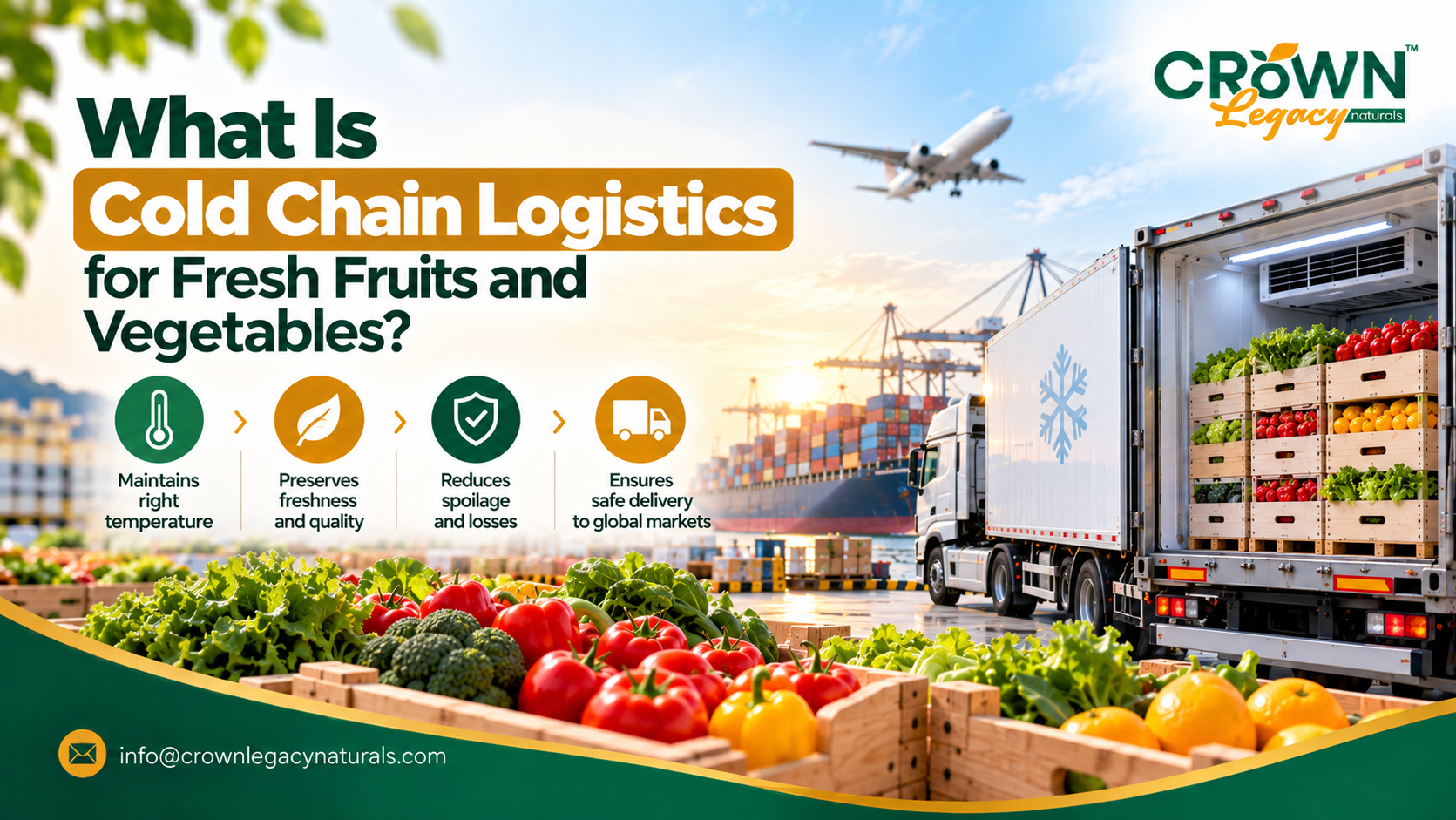
Cold chain logistics for fresh fruits and vegetables is the process of managing suitable temperature and handling conditions throughout storage, transportation, and distribution. It helps slow deterioration, maintain produce quality, and reduce avoidable losses during transit. For international buyers and exporters, an effective cold chain connects harvesting, pre-cooling, storage, packaging, transportation, and delivery while accounting for the specific needs of each fruit or vegetable.
What Is Cold Chain Logistics for Fresh Produce?
Cold chain logistics for fruit exports is a temperature-managed supply chain designed to protect products that can deteriorate when exposed to unsuitable conditions. For fresh produce, it involves more than refrigerated transportation: temperature management needs to begin at the appropriate stage after harvest and continue throughout the shipment.
The process may include:
- Harvesting and moving produce promptly
- Removing field heat where appropriate
- Maintaining product-specific storage temperatures
- Using suitable packaging and ventilation
- Transporting produce under appropriate conditions
- Monitoring temperature during storage and transit
- Coordinating delivery to minimise unnecessary delays
Cold chain logistics for fresh fruits and vegetables must account for differences between commodities. Some fresh produce benefits from low temperatures, while other products can suffer chilling injury if stored too cold.
Why Is Cold Chain Logistics Important for Fresh Fruits and Vegetables?
Fresh fruits and vegetables continue to respire after harvest. They can lose moisture, soften, ripen, or deteriorate depending on temperature, humidity, handling, and exposure to ethylene. Without suitable temperature management, produce may lose quality before reaching its destination, particularly during long-distance transportation.
Cold chain logistics for fresh produce helps manage these risks by maintaining suitable conditions during storage, transportation, and distribution. It connects post-harvest handling with refrigerated storage and transport, helping buyers and exporters protect produce quality and preserve its remaining shelf life.
The importance of cold chain logistics extends beyond refrigeration. Effective fresh produce cold chain management also involves timely pre-cooling where appropriate, suitable packaging, proper airflow, temperature monitoring, and coordination between everyone handling the shipment.
How Does Cold Chain Management Help Maintain Produce Quality?
Suitable temperature management can slow deterioration, reduce excessive moisture loss, and help maintain the texture and appearance of fresh produce. However, different fruits and vegetables have different storage requirements, so the temperature must be selected according to the specific commodity.
For international shipments, temperature-controlled logistics for fresh produce helps manage conditions from post-harvest handling through transportation and delivery. Monitoring these conditions can also help identify temperature deviations that may affect the shipment.
What Can Happen When Cold Chain Conditions Are Not Maintained?
Poor temperature management of cold chain logistics for vegetable exports can contribute to premature ripening, softening, shrivelling, decay, chilling injury, or a shorter marketable shelf life. These issues may affect the quality accepted by importers and increase the risk of losses during distribution.
A suitable cold chain cannot eliminate every source of deterioration, but it helps reduce avoidable risks when combined with careful harvesting, appropriate packaging, proper handling, and a well-planned transport schedule.
What Are the Main Stages of Cold Chain Logistics?
Cold chain logistics for vegetable exports and Cold chain logistics for fruit exports consists of connected stages that protect produce from the point of harvest until delivery. A weakness at one stage can affect the quality achieved by every later stage.
1. Harvesting and initial handling
Produce should be harvested at a suitable maturity stage and handled carefully to limit bruising, cuts, contamination, and unnecessary exposure to heat. Prompt movement from the field helps prepare it for the next stage.
2. Pre-cooling
Pre-cooling removes field heat from produce when appropriate. The method and timing depend on the commodity, maturity, volume, and handling system. Not every fruit or vegetable requires the same pre-cooling method.
3. Cold storage
Refrigerated storage helps maintain suitable conditions before packing or dispatch. Temperature, humidity, airflow, hygiene, and storage duration should be appropriate for the product.
4. Sorting, grading, and packaging
Produce is inspected and packed according to the order’s specifications. Packaging should protect against physical damage while allowing suitable ventilation and supporting temperature management.
5. Refrigerated transportation
Refrigerated trucks, containers, or other suitable transport systems maintain the required conditions during transit. Proper loading and airflow are important to avoid uneven temperature distribution.
6. Destination handling and delivery
At arrival, the shipment should be handled promptly and checked according to the buyer’s requirements. Minimising unnecessary delays and temperature exposure helps protect the remaining shelf life.
How Does Cold Chain Logistics Differ for Fruits and Vegetables?
Fruits and vegetables have different respiration rates, moisture needs, ripening patterns, and sensitivity to low temperatures. Consequently, cold chain logistics for fresh fruits and vegetables must be adapted to the product rather than managed as a uniform process.
Cold Chain Logistics for Fruits
Cold chain logistics for fruit exports is important because fruit handling depends on the species and maturity stage. Some fruits are harvested mature but unripe and continue ripening during distribution. Others require careful humidity and temperature management to preserve firmness and reduce moisture loss.
Exporters and buyers should consider:
- Harvest maturity
- Ripening behaviour
- Sensitivity to chilling
- Moisture loss and decay risks
- Expected transit time
- Remaining shelf life on arrival
Cold Chain Logistics for Vegetables
Cold chain logistics for vegetable exports is important because vegetables can lose water quickly and may be vulnerable to wilting, yellowing, bruising, or decay. Leafy vegetables, gourds, okra, and other vegetable types have different temperature and humidity requirements.
Vegetable cold chain planning should account for:
- Product-specific cooling requirements
- Moisture retention
- Ventilation and airflow
- Physical protection during loading
- Sensitivity to chilling or freezing
- Expected delivery and distribution conditions
What Equipment Is Used in Cold Chain Logistics?
Cold chain logistics for fresh fruits and vegetables may use several types of equipment, depending on the product and shipment route.
Equipment | Purpose |
Pre-cooling systems | Remove field heat where appropriate |
Cold storage rooms | Maintain suitable conditions before dispatch |
Refrigerated trucks | Transport produce under controlled conditions by road |
Refrigerated shipping containers | Maintain suitable conditions during ocean transport |
Refrigerated air cargo facilities | Support temperature-sensitive air freight handling |
Temperature data loggers | Record temperature conditions during storage or transit |
Monitoring sensors | Help track conditions and identify potential deviations |
Ventilated packaging | Support airflow and protect produce during handling |
Equipment alone does not guarantee an effective cold chain. Correct settings, maintenance, loading practices, monitoring, and trained handling are also important.
How Does Cold Chain Logistics Support Fresh Produce Exports from India?
For exporters shipping fresh produce from India, cold chain planning connects post-harvest handling with the transport method and the destination’s requirements. The appropriate approach depends on the product, origin, shipment size, route, season, and expected transit duration.
International shipments may involve refrigerated road transport, cold storage before dispatch, refrigerated sea containers, or temperature-managed air cargo handling.
A practical export plan should confirm:
- The required temperature and humidity conditions for the product.
- Whether pre-cooling is needed and how it will be performed.
- The packaging and ventilation requirements.
- The selected transportation method and expected transit time.
- How temperature conditions will be monitored.
- The receiving arrangements at the destination.
- The remaining shelf life required when the produce arrives.
Cold chain logistics for fresh fruits and vegetables is especially important for long-distance shipments because produce must retain suitable quality throughout handling and transportation, not merely at the point of dispatch.
How Crown Legacy Naturals Helps Buyers Source Fresh Produce?
Crown Legacy Naturals connects international buyers with fresh fruits and vegetables sourced from India. When planning an order, buyers can share their preferred produce, quantity, destination, and expected purchasing schedule to begin discussing suitable sourcing options.
Cold chain arrangements should be evaluated according to the specific product and shipment route. Buyers and exporters should clarify handling requirements, packaging, transportation, and expected delivery conditions before finalising an order.
Conclusion
Cold chain logistics for fresh fruits and vegetables helps protect produce quality by coordinating appropriate handling, cooling, storage, transportation, and delivery conditions. Its effectiveness depends on understanding the needs of each commodity and maintaining suitable conditions across the entire supply chain.
For international buyers, discussing temperature requirements, packaging, transit time, monitoring, and destination handling before dispatch can support better sourcing and shipment planning.
Crown Legacy Naturals helps international buyers explore fresh produce sourcing options from India based on their product and destination requirements.