
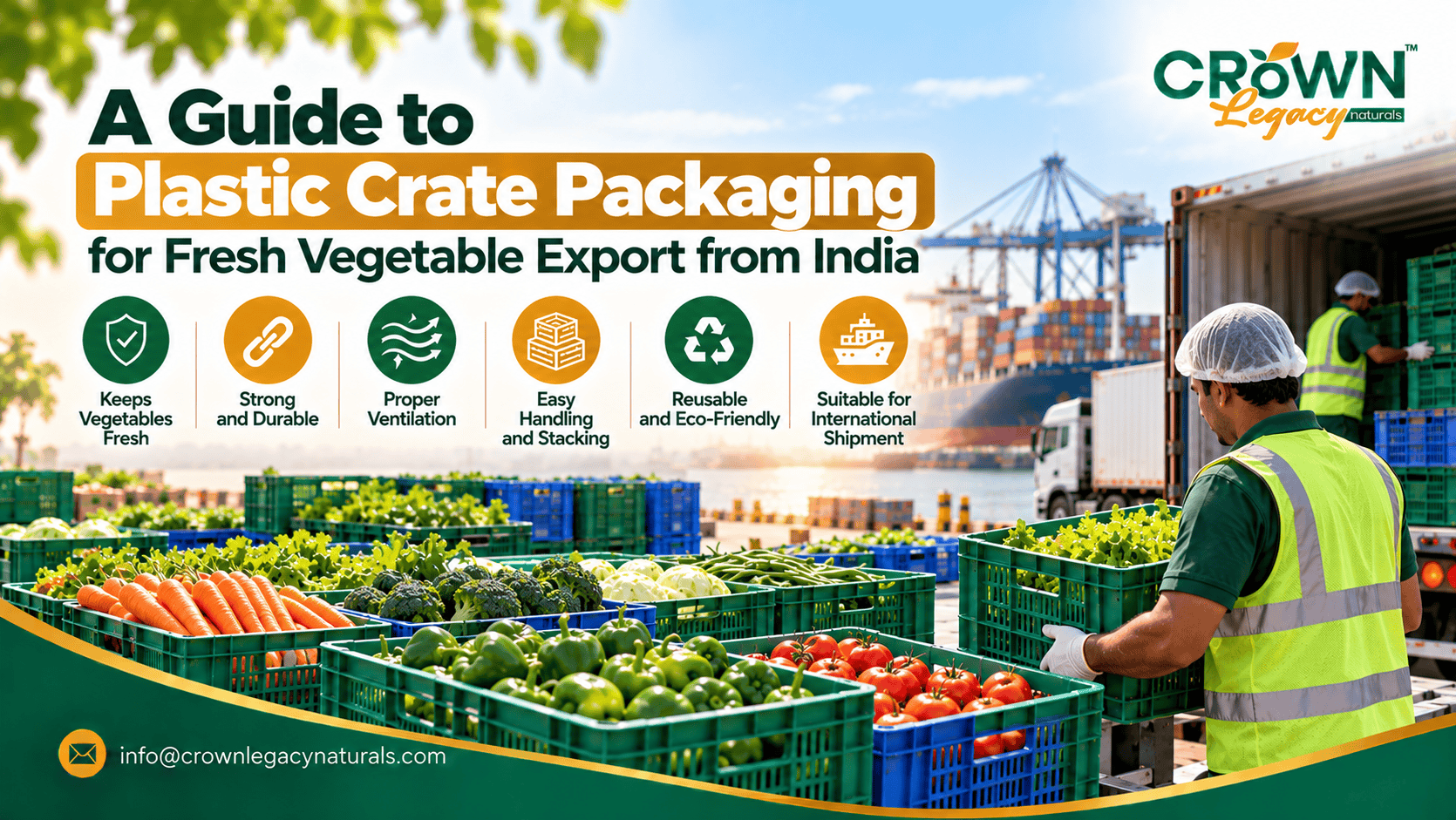
Plastic crate packaging for fresh vegetable export from India helps organise, protect, and transport vegetables during packing, storage, handling, and distribution. Suitable crates can support ventilation, reduce excessive compression, and improve handling efficiency when selected for the produce and supply chain. Importers should assess crate dimensions, material, load capacity, cleanliness, stackability, and destination requirements before choosing a packaging system.
What Is Plastic Crate Packaging for Fresh Vegetable Export from India?
Plastic crate packaging for fresh vegetable export from India involves using reusable or single-trip plastic crates, depending on the supply chain, to hold vegetables during handling and transportation. These crates are available in different sizes, designs, and load capacities to suit different produce types and logistics requirements.
Compared with some other packaging formats, plastic crates can offer rigid sides, ventilation openings, and stackable designs. Their suitability depends on the type of vegetable, packing arrangement, journey duration, handling practices, and whether crates are returned for reuse.
For international shipments, buyers should also establish whether plastic crates are intended for use throughout the export journey or only during collection, sorting, and domestic transport before the produce is transferred into export cartons.
Common features include:
- Rigid construction: Helps the crate retain its shape under appropriate loading conditions.
- Ventilation openings: May support airflow around the produce.
- Stackable design: Helps organise crates during storage and handling.
- Reusable construction: Some crates can be cleaned and reused when suitable procedures are followed.
- Different sizes and capacities: Allows selection according to the vegetable type and intended load.
Why Are Plastic Crates for Vegetable Export Important?
Plastic crates for vegetable export can help protect produce from excessive handling damage, organise packing operations, and support efficient movement between collection points, packing facilities, storage areas, and distribution locations. Their effectiveness depends on the crate design, loading practices, and conditions throughout the supply chain.
1. Help Reduce Physical Damage
Vegetables can be damaged by crushing, rough handling, excessive stacking pressure, or movement inside unsuitable containers. Rigid crates can provide a stable enclosure and help limit these risks when their dimensions and load limits are appropriate for the produce.
The crate should not be overloaded, and vegetables should be arranged to avoid unnecessary pressure on delicate items. Internal separation or other protective measures may be useful for certain products.
2. Support Ventilation
Ventilated crates can allow air to move around the produce, depending on the crate design and stacking arrangement. This may help support cooling and storage processes when used with suitable temperature management.
However, ventilation openings alone do not keep vegetables fresh. Temperature, humidity, produce condition, and handling practices remain important factors.
3. Improve Handling and Stacking
Uniform crate dimensions can make it easier to organise vegetables during collection, sorting, storage, and movement through packing facilities. Stackable designs can also help use storage space more efficiently.
Importers should check whether loaded crates remain stable when stacked and whether the design is suitable for the handling equipment used in the supply chain.
4. Support Reusable Packaging Systems
Some plastic crates are designed for repeated use. When return logistics, cleaning, inspection, and crate tracking are properly managed, reusable packaging may help reduce repeated purchases of single-use containers.
However, reusable crates require suitable cleaning and maintenance. Damaged, contaminated, or poorly maintained crates may create product protection and hygiene concerns.
Which Vegetables Are Suitable for Plastic Crate Packaging?
Plastic crate packaging can be used for a range of vegetables, but the most suitable design depends on each product’s size, firmness, shape, moisture characteristics, and susceptibility to damage. Buyers should match crate dimensions and loading practices to the vegetables being transported.
Vegetable | Important crate considerations |
Okra | Avoid excessive compression and allow suitable airflow |
Green chillies | Use an appropriate load depth to reduce crushing |
Drumsticks | Select crate dimensions that accommodate product length |
Bitter gourd | Consider product shape, stacking, and protection from impact |
Cluster beans | Avoid overfilling and excessive pressure on the produce |
Ginger | Consider crate strength, cleanliness, and handling of heavier loads |
Turmeric | Select a suitable crate for the product’s condition and intended handling |
Tomatoes | Use careful loading and suitable support to limit crushing |
Green peas | Consider the packaging arrangement and temperature management |
Cauliflower | Allow adequate space to reduce compression and physical damage |
These are general considerations rather than fixed packing specifications. The appropriate packaging should be confirmed for the product, variety, shipment quantity, and intended transport conditions.
What Are the Plastic Crate Specifications for Vegetable Export?
Plastic crate specifications for vegetable export should define the crate’s dimensions, material, load limits, ventilation design, stacking requirements, and hygiene expectations. A written specification helps buyers,vegetable exporters, and packaging suppliers work from the same requirements and reduces confusion when ordering crates for repeat shipments.
Use the following checklist when reviewing crate options.
Specification | What buyers should confirm |
Dimensions | Internal and external length, width, and height |
Material | Material type and suitability for intended use |
Capacity | Usable volume and recommended produce load |
Load rating | Permitted load under the manufacturer’s specified conditions |
Stackability | Stability when empty and loaded |
Ventilation | Opening size, position, and airflow considerations |
Drainage | Whether drainage openings are required |
Surface finish | Smooth edges and absence of damage that could affect produce |
Cleaning | Suitable cleaning method and maintenance requirements |
Reuse | Intended reuse conditions and inspection procedures |
Pallet compatibility | Fit with the planned pallet and handling system |
Identification | Colour coding, labels, or tracking details where needed |
Should Buyers Test Plastic Crates Before Bulk Orders?
A sample review can help buyers confirm the crate dimensions, fit, handling comfort, ventilation pattern, and compatibility with their vegetables. Where load-bearing performance is important, buyers should also request relevant manufacturer specifications or testing information.
Testing should reflect the intended application. A crate used for light vegetables in short-distance handling may not need the same performance characteristics as one carrying heavier produce through a demanding distribution chain.
Before approving a bulk order, buyers should also check whether the supplied crates match the approved sample and specification.
What Should Importers Check Before Choosing Plastic Crates for Vegetable Export?
Before selecting plastic crates for vegetable export, importers should establish how the crates will be used, what vegetables they will hold, and whether they are suitable for the planned handling and shipping system. A checklist can help identify requirements before procurement or shipment preparation.
- Confirm the vegetable type, size, and expected load per crate.
- Check internal and external crate dimensions.
- Verify material suitability for the intended use.
- Review load ratings and stacking stability.
- Assess ventilation and drainage needs.
- Check for smooth surfaces and damage-free construction.
- Confirm cleaning and reuse procedures where applicable.
- Check compatibility with pallets and handling equipment.
- Confirm whether crates are for domestic handling or final export transport.
- Verify destination-specific packaging, hygiene, or material requirements with the relevant parties.
- Agree on responsibility for crate supply, collection, and return where applicable.
The final choice should be based on the actual product and supply chain rather than crate price or appearance alone.
How Crown Legacy Naturals Supports Fresh Vegetable Buyers?
Crown Legacy Naturals connects international buyers with fresh fruits and vegetables sourced from India. For buyers evaluating packaging options, discussing vegetable types, packing quantities, handling needs, and destination requirements early can help clarify the most suitable approach for a shipment.
Importers can share their preferred vegetables, target market, and packaging expectations as part of the sourcing discussion. The final packaging format and any applicable requirements should be confirmed according to the product, transport method, and destination market.
Conclusion
Plastic crate packaging for fresh vegetable export from India can support produce handling, storage, ventilation, and transportation when crates are chosen for the specific vegetables and logistics conditions. Buyers should assess crate dimensions, material, load capacity, stackability, cleanability, and compatibility with the final export packaging system.
Understanding plastic crates for vegetable export, export quality plastic crates for vegetables, and plastic crate specifications for vegetable export helps importers make more informed packaging decisions. By matching the crate design to the product and supply chain, buyers can better organise handling and reduce avoidable packaging-related risks.
Crown Legacy Naturals helps international buyers explore fresh vegetable sourcing options from India and discuss product and packing requirements as part of the purchasing process.