
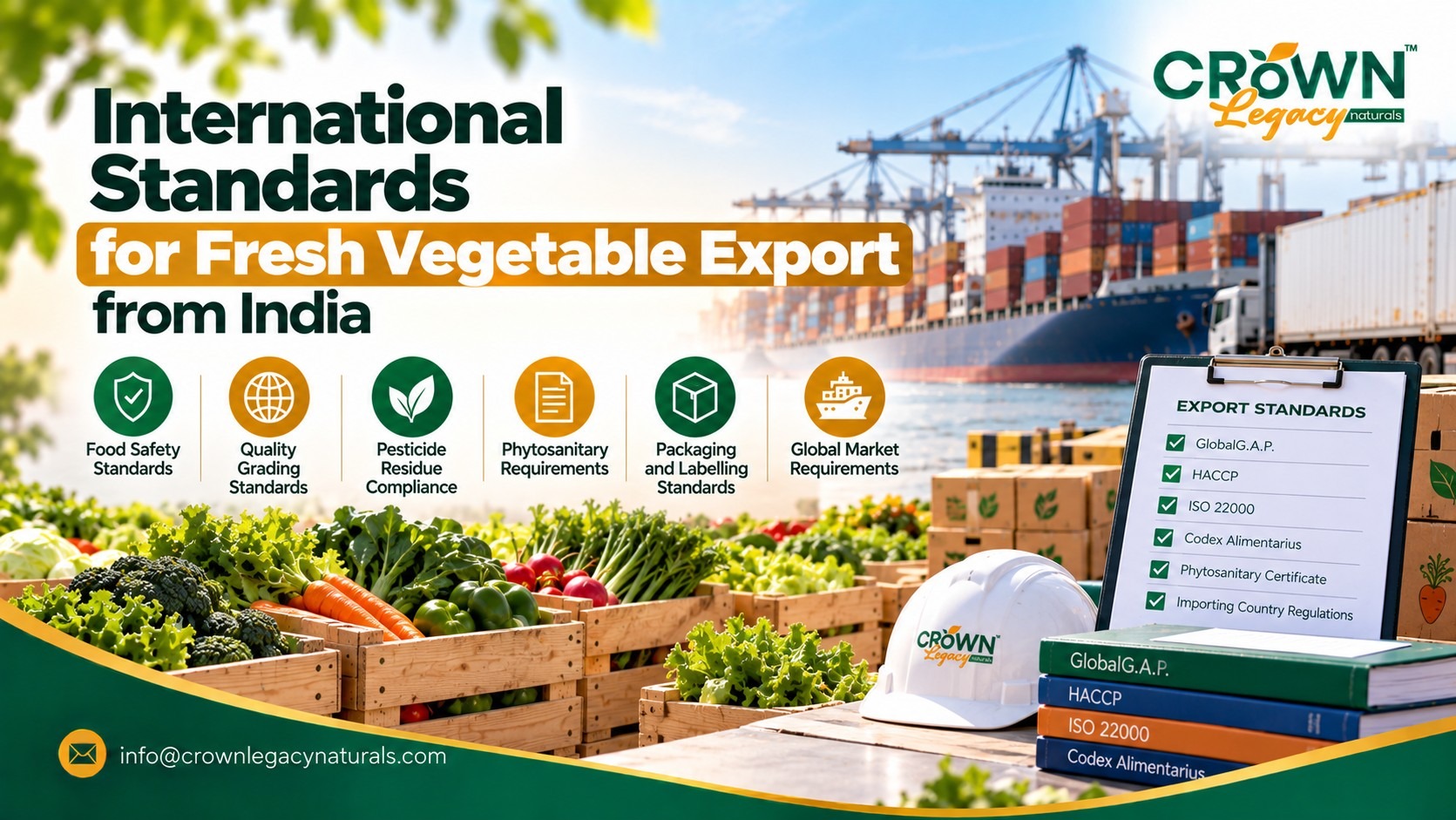
International standards for fresh vegetable exporters from India cover produce quality, food safety, pesticide residue limits, pest control, packaging, traceability and destination-specific import rules. Indian exporters must verify the requirements of the receiving country and the specific vegetable before shipment. Meeting these standards helps importers assess product quality, reduce border delays and maintain consistent supply chains.
Why Are International Standards Important for Fresh Vegetable Exports?
International standards help ensure that vegetables shipped across borders meet the importing country’s food safety, plant health and commercial requirements. For importers, these checks help reduce the risk of rejected consignments, quality disputes and losses caused by unsuitable produce or incomplete documentation.
Fresh vegetables are perishable, so even a compliant shipment can face problems if harvesting, handling, cooling or transportation is poorly managed. Exporters and buyers should agree on product specifications before the consignment is packed.
Key areas covered by fresh vegetable export standards from India include:
- Quality and grading: Size, maturity, colour, appearance and acceptable defects.
- Food safety: Pesticide residues, contamination risks and hygiene.
- Plant health: Pest and disease controls, including phytosanitary documentation where required.
- Packaging and labelling: Suitable packaging materials and accurate shipment information.
- Traceability: Records linking produce to farms, suppliers, packing facilities and test results.
- Import compliance: The destination country’s applicable rules and commodity-specific conditions.
The exact requirements vary by vegetable and destination. A shipment of okra may face different import conditions from one containing ginger, green chilli or drumstick.
Fresh Vegetable Export Quality Standards
Fresh vegetable export quality standards define the condition in which produce must arrive at the buyer’s facility. Importers commonly specify acceptable size, freshness, colour, maturity, uniformity, physical damage and tolerance for defects in their purchase agreements.
A vegetable can look acceptable at dispatch but deteriorate during transit if it is over-mature, bruised, poorly packed or exposed to unsuitable temperatures. Quality checks should therefore consider both the condition at packing and the expected condition on arrival.
Quality factor | What exporters should check |
Freshness | Produce should be fresh and suitable for the intended market |
Appearance | Colour and shape should match the agreed product specification |
Maturity | Vegetables should be harvested at the appropriate stage |
Physical damage | Check for cuts, bruises, crushing and excessive breakage |
Pests and disease | Inspect for visible infestation, rot and disease symptoms |
Foreign matter | Remove soil, unwanted plant material and other contaminants where required |
Uniformity | Follow agreed sizing, grading and packing tolerances |
Shelf life | Consider transit time, storage conditions and expected distribution time |
How Do Quality Standards Differ by Vegetable?
The buyer’s specification should reflect the characteristics of each product rather than applying one grading rule to every vegetable.
- Okra (bhindi): Check tenderness, size, colour, surface damage and signs of deterioration.
- Green chilli: Assess colour, firmness, maturity, shrivelling and physical damage.
- Drumstick (moringa): Check pod maturity, straightness where specified, breakage and freshness.
- Bitter gourd: Inspect size, shape, colour, skin condition and signs of decay.
- Cluster beans: Check tenderness, pod condition, uniformity and visible defects.
- Ginger and turmeric: Agree on acceptable rhizome size, cleanliness, maturity and condition according to the product’s preparation and intended use.
These are practical quality checks, not universal legal grading specifications. Importers should confirm the exact tolerances required by their destination market and purchasing contract.
Vegetable Export Regulations in India
Vegetable export regulations in India involve the relevant export procedures, documentation, plant quarantine requirements and any destination-specific certification or inspection obligations. Exporters should identify the rules that apply to their product and shipment instead of assuming that all fresh vegetables follow an identical certification process.
APEDA provides export-related guidance, including standard operating procedures, packaging standards, export procedures and information on importing-country regulations. Its HortiNet system supports specified fresh horticultural export processes and traceability.
Common Compliance Steps for Indian Vegetable Exporters
Step | Action to take |
1. Confirm product and destination | Identify the vegetable, destination country, intended use and applicable import conditions |
2. Verify export documentation | Check current requirements for commercial and shipment documents |
3. Confirm sourcing records | Maintain supplier and farm details needed for traceability or applicable schemes |
4. Arrange testing and inspection | Complete required residue analysis, quality checks or inspections |
5. Prepare the consignment | Grade, pack, label and handle vegetables according to agreed specifications |
6. Obtain applicable certificates | Arrange phytosanitary and other required certificates through authorised channels |
7. Verify before dispatch | Ensure documents, shipment details and product condition are consistent |
The exact requirements can change based on the importing country, commodity and any special trade conditions. Exporters should check the latest official guidance before every new market entry or shipment.
Vegetable Export Standards for International Markets
Vegetable export standards for international markets are not identical across all destinations. Each importing country may set its own requirements for pesticide residues, plant pests, food safety, labelling, packaging, inspections and supporting documentation. Exporters should verify these conditions before confirming an order.
For example, the European Union has specific legislation for pesticide MRLs, while phytosanitary entry conditions depend on the relevant plant health rules and commodity. Other destinations may require different documents for fresh produce export, inspections or treatments.
What Should Importers and Exporters Verify by Destination?
Compliance area | What to confirm |
United Kingdom and European Union | Applicable pesticide MRLs, plant health conditions, border procedures, labelling and any required certificates |
United States | Applicable plant import conditions, pest restrictions, food safety obligations and shipment documentation |
Gulf markets | Country-specific plant health, food safety, labelling and import documentation rules |
Asian markets | Destination-specific quarantine measures, pesticide limits, product conditions and inspection requirements |
This table is a starting point, not a complete list of legal requirements for each market. The importer or exporter should check official destination-country sources for the exact vegetable and country of origin before shipment.
What Records Should Exporters Maintain?
A practical record set may include:
- Supplier and farm identification.
- Harvest and procurement dates.
- Lot or batch numbers.
- Grading and inspection results.
- Pesticide application records where available and relevant.
- Laboratory reports required by the buyer or destination.
- Packing details and final consignment quantities.
- Applicable certificates and shipping documentation.
Traceability records should remain consistent across the supply chain. If a test report refers to a different lot from the one being shipped, the importer may be unable to verify that the results apply to the consignment.
How Crown Legacy Naturals Supports Fresh Vegetable Export Requirements?
International buyers need a clear understanding of product specifications, packing preferences, shipment documentation and destination-market requirements before sourcing fresh vegetables from India.
Crown Legacy Naturals connects international buyers with Indian fresh produce, including okra, green chilli, drumstick, bitter gourd, cluster beans, ginger and turmeric. Buyers can discuss their product requirements, preferred packaging and destination-market needs when planning an order.
For a smoother sourcing process, importers should share their required grades, quantity, packaging format, delivery schedule and any applicable compliance specifications early. These details help both parties clarify expectations before shipment preparation.
Conclusion
Meeting the international standards for fresh vegetable export from India requires more than selecting fresh produce. Exporters must consider quality grading, pesticide residue limits, phytosanitary requirements, suitable packaging, traceability and the regulations of the destination country.
Importers can reduce shipment risks by confirming product specifications, checking current import conditions and reviewing the necessary inspection and certification documents before dispatch. Because requirements vary by vegetable and destination, each consignment should be assessed individually.